

The algorithm of Niranjan’s life was operating at peak efficiency. IIT Kanpur had stamped him with a premium grade, and the campus placement cell had duly funnelled him into a multinational firm with a compensation package that felt almost rude to discuss aloud.
When he arrived in Ahmedabad to claim his destiny, he did what any self-respecting, upwardly mobile bachelor would do: he rented a three-BHK on the twentieth floor of a gleaming high-rise in South Bopal. The apartment was a cavern of echoey, minimalist promise, far too large for a single man, but precisely the right size for his trajectory. He purchased a sedan that still smelled of factory plastics, parking it in the stilt basement alongside dozens of identical vehicles belonging to dozens of identical young men.
Then, his parents arrived for their mandatory inspection of his success.
They were gentle, provincial people from a town where life moved at the speed of a ceiling fan on number two. His mother instantly declared the twentieth floor to be “practically in the clouds” and worried about the water pressure. His father, possessing the restless anxiety of a retired government servant, immediately noticed that Niranjan’s brand-new car was coated in a fine, stubborn layer of Amdabadi dust. Niranjan, after all, was drowning beautifully in seventy-hour work weeks. He had time to analyse predictive data structures; he did not have time to wield a microfiber cloth.
“A man’s vehicle is his face to society,” his father remarked over morning tea, staring out at the hazy Ahmedabad skyline. “It shouldn’t look exhausted.”
The hierarchy of a modern Indian apartment complex is governed not by the housing society board, but by the security guards at the gate. Niranjan’s father, utilising the universal language of retired elders, struck up a deep, conspiratorial friendship with Santosh, the night-watchman.
And, within twenty-four hours, Santosh had procured Sudhir.
Sudhir was a lean, perpetually sunburned young man who seemed to exist in a state of liquid motion. He already cleaned fourteen cars in the basement every morning, moving between them like a hyperactive spirit with a bucket of soapy water.
During his brief interactions with Niranjan’s father, Sudhir revealed a resume that was a chaotic tapestry of modern India’s gig economy. He had pumped fuel at a Reliance station, sorted inventory at a mall during the Diwali rush, and hauled crates in a manufacturing unit in GIDC. He had no specific skill, but he possessed a terrifying, cheerful willingness to do absolutely anything.
“Work is work, Uncle,” Sudhir had said, his teeth flashing white against his tanned face. He rubbed his thumb against his index and middle fingers in the universal, rhythmic gesture of financial ambition. “Hard work is fine. Easy work is fine. The color of the note at the end of the month just needs to be right.”
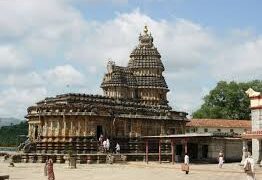
Niranjan’s father liked him. He paid Sudhir two months in advance, gave him a box of sweets, and took Niranjan on a dutiful pilgrimage to Somnath and Dwarka. The car was spotless throughout the journey, reflecting the ancient temple spires in its gleaming bonnet.
Three years dissolved into the corporate ether. Niranjan’s life updated its software.
His bachelor days ended with an arranged marriage to a girl with an MBA and a deep appreciation for high-end cookware. Naturally, the three-BHK in South Bopal was deemed insufficient for a family man. Niranjan bought a premium apartment in a more prestigious pincode, traded the sedan for a massive, imposing SUV that required a small step-ladder to climb into, and settled into the quiet, comfortable numbness of EMI payments.
Once again, the parents materialised to help the newlyweds navigate the dizzying logistics of setting up a smart home. There were water purifiers to install, motorised curtains to calibrate, and a modular kitchen that looked like the control room of a submarine.
To reward them for their labour, Niranjan planned a weekend getaway. The destination was inevitable: the Statue of Unity at Kevadiya near Vadodara. It was the pilgrimage of the new India—a colossal testament to engineering, patriotism, and curated tourism.
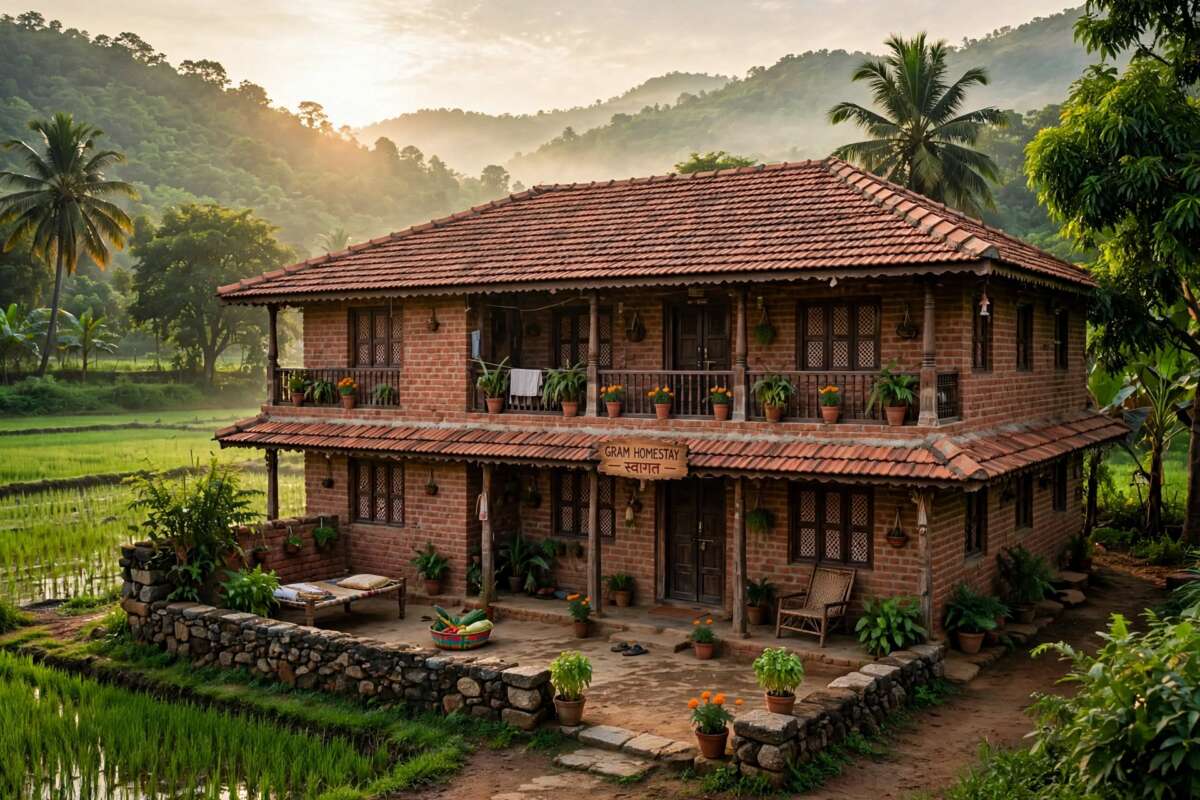
“We won’t stay in a soulless five-star hotel,” Niranjan announced at the dinner table, scrolling through his phone with the practised efficiency of a man who optimises his leisure. “I’ve booked a premium homestay through an exclusive app. It’s an authentic, immersive rural experience. It’s a traditional cottage, but with high-speed Wi-Fi and air conditioning. It’s highly rated for its ‘local touch.'”
The drive from Ahmedabad was smooth, the massive SUV swallowing the highway with arrogant ease. As they neared Kevadiya, the landscape shifted.
The towering bronze form of Sardar Patel loomed on the horizon, a modern colossus slicing through the rural sky. The contrast was stark: manicured tourist plazas, electric buses, and pristine food courts, all built upon land where tribal villages had stood for generations.
Following the precise, nasal dictates of the GPS, Niranjan turned off the main highway onto a narrow, paved road that wound through a manicured “heritage village.” The homestay was beautiful—a beautifully restored vernacular structure with a terracotta roof, surrounded by marigold bushes. It looked exactly like its pictures online.
Niranjan parked the SUV, stepped out into the humid afternoon air, and stretched his back. A man in a crisp, white linen shirt and spotless khakis emerged from the shade of the porch to greet them.
“Welcome, sir. Welcome, Uncle, Aunty,” the man said, bowing slightly.
Niranjan’s father stopped dead. His mother adjusted her spectacles. Niranjan blinked, his analytical mind briefly stuttering.
It was Sudhir.
His hair was neatly parted, his skin was less sunburned, and he wore a smartwatch that flickered with notifications. But the smile was identical.
“Sudhir?” Niranjan’s father gasped, his voice a mixture of delight and profound confusion. “You? Here? But… I thought you were cleaning cars in Bopal!”
Sudhir laughed, a warm, resonant sound. He stepped forward immediately, bending down to touch the feet of Niranjan’s parents with genuine, old-world reverence.
“Ah, Uncle, that was three years ago,” Sudhir said, straightening up. “I told you back then—I am ready to do any work, as long as the money is right.” He gave the familiar, playful flick of his fingers, though this time his hand was manicured.
“You bought this place?” Niranjan asked, his voice tightening slightly. He felt a strange, uninvited prickle of discomfort. He was the IIT graduate; he was the multinational manager. He understood systems and scale.
“Oh, no, sir,” Sudhir replied modestly, waving his hand. “I don’t own just this cottage. I leased the land from the local villagers when the government started the development project. I run six of these homestays under my agency now. I also have the contract for the laundry services for two of the major resorts near the statue, and I own four of the electric vehicles that ferry the VVIP tourists.”
Niranjan stood frozen in the courtyard of the authentic rural experience he had paid twelve thousand rupees a night to enjoy. The afternoon silence was heavy, broken only by the distant hum of tourist buses.
Sudhir smiled gently, gesturing toward the beautiful, air-conditioned cottage. “Please, come inside. Refresh yourselves. I have instructed my staff to prepare fresh Gujarati snacks for you.”
As his parents walked ahead, marvelling at the strange turns of destiny, Niranjan remained by the car for a moment. He looked at his massive, expensive SUV, and then looked at Sudhir, who was now politely taking their luggage from the boot.
Niranjan realised, with a quiet, devastating clarity, that while he had been climbing the corporate ladder one carefully calculated rung at a time, Sudhir had simply bought the ladder.