

‘Tomorrow, Martin, don’t forget.’ As usual, Karla had the last word.
I hung the telephone back on its hook and flexed my fingers, cramped from gripping the heavy black plastic. Several small silver coins shot into the return tray, but I was too exasperated to bother fishing them out. I stepped out of the phone box onto the street, where a chilly autumn wind was waiting.
I just could not escape this woman. I was here in Zagreb to film a travel documentary, and Karla was ten thousand kilometres away in our apartment in Santiago. But even though I was very glad to get away from Karla for a while, and had decided to use this time apart to decide what to do about our terrible relationship, I still felt compelled to telephone her regularly. And each time, I felt just as entangled and trapped as I did at home. I couldn’t remember anything about the conversation we’d just had except that I’d promised, in order to get off the phone, to ring her again at the same time tomorrow; breakfast time here, siesta time for her in Santiago. Now this obligation loomed over my next twenty-four hours.
Karla and I had been together for five years. At the beginning, I thought it almost miraculous that I’d found such a woman. I was barely twenty, she twenty-three, and I was fascinated by her combination of dark blue eyes, copper skin and jet-black hair. I took the sharp, sarcastic way she habitually spoke to reflect her intellectual and emotional maturity. It was late summer when we met, and we spent the hot, sticky afternoons lying on my crumpled bed, the window propped open to catch any hint of a breeze, Karla’s hair spread out like a glossy black flag on the pillows, her skin glistening with sweat. At night we watched old movies, listened to cumbia bands in small clubs, ate in all-night diners. And everywhere, we walked arm in arm, a single unit.
But that was five years ago. Now our daily relations were frozen, made up entirely of drawn-out circular arguments or black silences. Karla was perpetually, caustically critical of me, yet clinging, fiercely jealous of anyone I might even speak to.
‘Why do you stay with her? Just go, man, get out,’ more than one of my friends had told me, more than once. And I understood their exasperation. I said I wanted to be free of Karla, yet I didn’t leave. I knew I was being weak, and could blame only myself for my situation, but that knowledge didn’t help me.
For today, though, I was free, in a city I knew and liked. It was Sunday, the streets almost empty and the shops closed. It seemed the right kind of day to visit Maksimir Park, so I turned down Praška Street towards the tram stop. I knew I should use this day of freedom to decide once and for all what to do about Karla, but all I could think of was that I didn’t have to speak to her again for twenty-four hours.
The tram arrived, less than half full. It was one of the older tramcars, its seats warmed by hot water pipes underneath, a luxury in an otherwise rudimentary means of transport. The passengers each sat alone, in the self-contained silence that hovers over any city on Sunday morning, and even more in a Catholic city like Zagreb. All the men wore hats or flat caps, all the women headscarves.
The autumn sky was low and colourless. The route passed through a suburb of stuccoed villas, standing amongst dark green conifers and leafless plane trees. Crows sitting on gables cawed at the passing tram. Their glossy blackness and the harsh, assured confidence with which they berated us reminded me so sharply of Karla that I almost expected to find her in a seat behind me.
Together with most of the other passengers, I got off at the tall wrought-iron gates of the park. On either side of the gateposts stretched a forbidding rank of tall firs, but inside were lawns and flowerbeds and small fountains, not playing now that winter was so near, but still elegant in a provincial way.
A broad gravel walk ran down the centre of the park, flanked by rows of lampposts and wooden benches. Pairs of young mothers pushed prams up one side of the walk and back down the other. As in any Central European park, a large concrete chessboard had attracted a group of white-haired men. On a bench, a girl with her hair bundled into a striped woollen cap sat reading a book. The whole scene was harmonious, pleasing.
I left the main path and climbed a grassy bank. A carpet of yellow and tan leaves, in the cut-out shapes of pin-oak, alder and linden, covered the lawn, giving off a smell of damp decay. From the top of the rise, the ground sloped away past an artificial lake, where two large swans were surging up and down, leaving a double wake in the leaden water. They didn’t look graceful and melancholy, as swans are supposed to look, but muscular and irritable.
Beyond that was a less manicured part of the park, where clumps of saplings fought for space among long-established trees. Blue smoke hung in the still air; they were burning the autumn leaves. I checked my watch; I still had twenty-two hours before I had to ring Karla.
Maybe in that time I could simply leave the country. Take my bag to the station and buy a ticket to Vienna, or Trieste, or even Breslau, the city my grandparents had emigrated from to Chile so long ago. For a moment I indulged myself in this fantasy, before grinding my teeth at my foolishness. Wherever I went, I would still have to ring Karla; it didn’t matter to her where I called from. Trains couldn’t help me. I had to help myself.
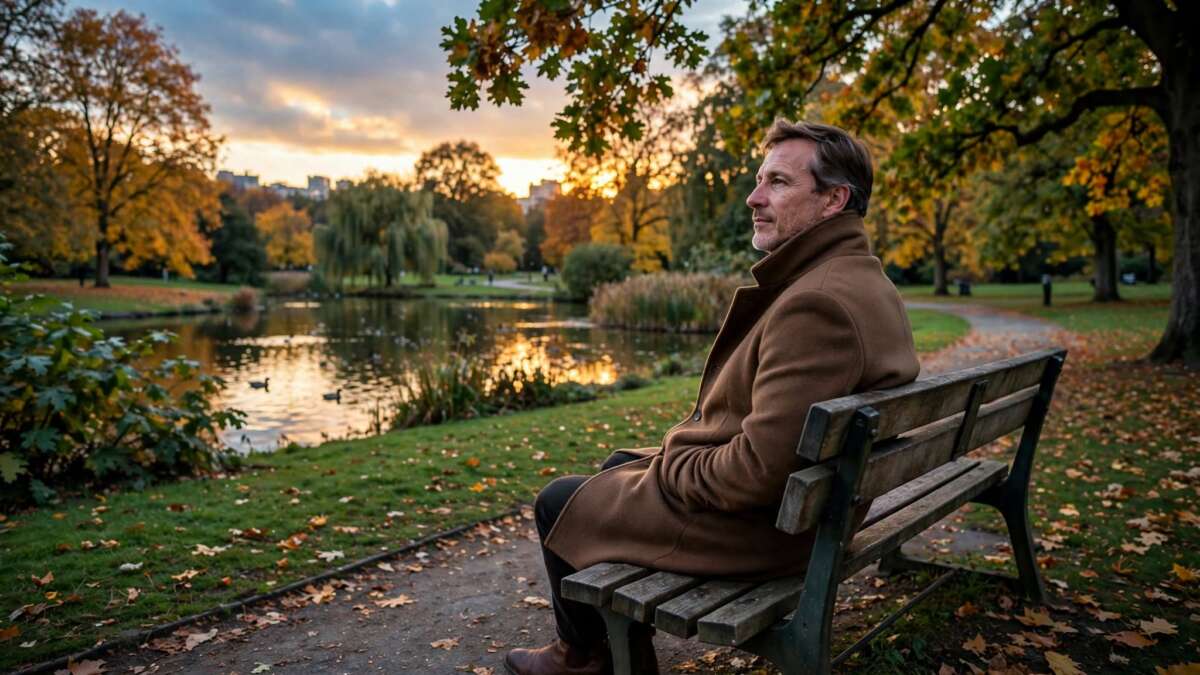
I was so absorbed in these circular, useless thoughts that I paid no attention to my surroundings as I walked. Now I found myself only a few paces from a wooden bench on top of a low hill, on which a man sat looking out over the park to the city beyond.
He was at least fifty, with a lean, hawk-nosed face and iron-grey hair swept back from his temples. He wore a soft brown overcoat with the collar turned up. Leaning back on the bench, legs stretched out, hands in his overcoat pockets, he didn’t glance at me, although I was close enough to speak to him. A sudden gust of wind blew up, and the shoals of fallen leaves shifted, some taking swirling flight. A flurry of them whipped around the figure on the bench; he didn’t appear to notice.
In that moment, it seemed to me that he was a man entirely in charge of his life. Of course, I had no idea what was in his mind; for all I knew he was in despair. But his immobility and calm gaze into the distance gave him an appearance of self-mastery. Looking at his face, marked with deep grooves beside the mouth, I couldn’t imagine him in thrall to Karla, checking the hours remaining until he had to telephone her. In that moment I would have exchanged lives with him, even though he was probably twice my age.
A short, brisk spatter of rain rattled on the leaves; time to leave the park. I turned my back on the seated man. A track through the trees led me back to the gates. The day had turned colder, and the women with prams had all departed. It was lunchtime, and I was hungry. I took the tram back to the centre, and looked around for somewhere to eat.
Nothing was open in the main square, so I took a street branching off it, a broad boulevard lined with solid pre-war buildings. Linden saplings had recently been planted in rectangles of sandy earth cut into the asphalt, each slender trunk tethered to wooden stakes with strips of hessian. Halfway along the block stood a sandwich-board. It bore a grinning, brightly-coloured cartoon fish, a chalked price, and a pointing hand directing me down a flight of stone steps.
I took the steps down to a large underground room. A cluster of people pressed around a glass-fronted booth, while others stood shoulder to shoulder at a counter along the back wall, eating. There seemed to be only one dish: fish and chips. When I got to the front of the crowd, a bulky, dyed-blonde woman in a blue pinafore barked at me, ‘Grilled or fried?’ – it sounded rather like ‘Guilty or not guilty?’ – yelled over her shoulder to a cook in a white T-shirt, took my money, and pushed a small numbered square of paper at me. Her blunt, square fingernails were lacquered bright pink.
I stepped back from the crush to wait. The smell of grilling fish and the tang of vinegar in the air made me even hungrier. A few minutes later my number was called and I was handed a wicker basket full of grilled fish and thick potato chips, with a few slices of bread pushed down one side. The fish was fresh, white and juicy, the chips hot and crisp, the bread crusty; a feast. I wolfed it down.
People were waiting to eat at the counter, so once I’d finished, I made for the exit, wiping my hands on a paper napkin and licking salt from the corners of my mouth. Near the top of the curving stairs I almost bumped into someone descending; it was the man in the brown overcoat whom I’d seen in Maksimir Park. I couldn’t help looking at him as we passed awkwardly on the narrow steps. His eyes were a very pale grey, with black, concentrated pupils.
It seemed odd to encounter this man again, as if I were somehow meant to see him. But Zagreb isn’t so large, and this café is obviously popular; why shouldn’t he be here for lunch? I glanced at my watch again. Immersed in the pleasure of eating my fish and chips, I had forgotten about Karla. Now I did think of her, I felt a bloom of anxiety in my chest. I really had to decide what to do about my situation.
I decided to walk up to the Old Town. The sun broke through the clouds as I climbed the long row of steps past the open-air vegetable market, deserted today, the stallholders’ spaces marked out by piles of waxed cardboard cartons. Grubby black-and-white cats prowled around or looked out slit-eyed from sheltered spots.
The steps were steep, and I was breathing hard by the time I reached the cobbled streets of the Old Town, lined with Habsburg-era buildings in ochre, pastel green or pale blue. I came to a small square where two taxis were parked, the drivers leaning on their open doors, smoking and talking. They broke off to look at me expectantly, but I shook my head and they went back to their conversation.
Turning down a narrow street between high, cream-plastered walls, I came out onto another square, where a handful of cane armchairs had been pushed into a wedge of sunlight outside a coffee shop. I found a seat and ordered a milk coffee; as always in the Balkans, it came with a paper doily on the saucer. I sat, sipping my coffee, half-listening to the fluid chatter of two women sitting nearby, smelling the perfume-laden cigarette smoke drifting from their table, and thinking that most people seemed to live their lives entirely free of the anxieties I allowed to consume me.
By the time I’d finished my coffee, the afternoon was noticeably cooler. The sun had slid below the line of rooftops, although it still glowingly lit up the red, white and blue tiles on top of St Mark’s church. It struck me there would be a fine view from the promenade overlooking the city centre.
Perched on the brow of a hill, facing west, the promenade was circled by a low stone wall. At its midpoint, a funicular railway ran down the steep slope to the town centre. From up there you could see the western sky spread out above the city, all the way out to the concrete apartment blocks of Novi Zagreb across the river.
When I reached the upper level, the sun was setting among low banks of cloud. The sky was suffused with pink, and as I watched, the clouds lying above the horizon were touched with molten gold. It was impossible to believe these clouds were merely water vapour; they seemed to be on fire, or more, made of fire. Not only the sky, but the air all around me was a hazy pink and orange, full of tiny pinpricks of light like specks of gold dust, so dense it seemed I could reach out and take handfuls of it. It was the most spectacular sunset I had ever seen.
Half a dozen couples stood at the parapet, looking west, not speaking, caught up in the evening’s overwhelming beauty. It struck me that in twenty years, they might look back on this as the moment they decided to marry, or have a child, or even elope. It was as vivid and magical a scene as that.
A tall, unshaven man in a tweed jacket leaned against the stone wall, playing an old-fashioned electric guitar through a small amplifier. He was improvising languidly and easily on a tune I recognised but couldn’t name, a romantic European standard, neither Volare nor Bitola but sounding like both of them. When he finished that song, he played another like it. It was exactly the right music to watch the sun set over Zagreb, over the Balkans, over Central Europe. The sweetly melancholy melodies wound around all of us there, and floated softly up into the darkening sky.
I couldn’t look away; I had to stay until the sunset had exhausted all its glory. I sat on a bench, surrounded by the rosy light.
Exactly half the ball of the sun now showed above the navy-blue stripe of the horizon. The sky flared for the last time, smoky pink over a base of raked, glowing coals. Then, within a minute, the sun vanished, the orange clouds became grey, and the last of the colour hastened away from the western sky, leaving behind pale lavender, then mauve, then purple. Looking up, I made out Jupiter’s single white dot high above. Day had folded over into night.
It was a lovely time to be there, to be alive. The evening air was cool, but soft. I felt a great swell of calm and contentment from the sunset, the music, and the reflected happiness of the couples around me. The guitarist packed up his instrument, scooping up the coins and coloured banknotes people had dropped into his open case. It didn’t look like he’d made much, but he had been part of a sublime, transfigured half-hour; perhaps he was satisfied with that.
I wanted to prolong my good mood as long as possible, and the funicular railway would transport me to the city below too abruptly. Instead, I looked towards the flight of concrete steps that zigzagged down the hillside. And there, standing near the end of the stone terrace, was once again the man in the brown overcoat, gazing out into the evening sky with the same untroubled expression he’d worn in Maksimir Park that morning.
This was the third time he’d appeared to me today; it must, surely, be for a reason. I remembered reading – was it in The Odyssey? – that the goddess Athena would appear, disguised as a man, to give mortals advice when it was most needed. And if this man were really Athena in disguise, I could make a pretty good guess what the divine advice would be:
‘Don’t call this woman, not tomorrow, not at all. And stop thinking about her. When you get home, tell her you needed some time to yourself, and let the chips fall where they may.’
As I stood there, hearing the first tentative crickets chirrup and feeling the damp air creep under my collar, the man in brown turned toward the stairs. He glanced at me. It was difficult to discern his features in the gloom, but I thought he was smiling. As he passed between the stone gateposts, he raised one gloved hand in an unmistakable salutation before setting off briskly down the steps. In a moment he was out of sight.
I was left alone on the terrace, breathing in the night air. So Athena had told me what I already knew. Or rather, I’d forced myself to admit what I knew all along. And then I remembered – it was The Odyssey, I was sure now – that Athena gave advice, but only advice; in the end she left humans to work out their own destinies. It was up to me to deal with Karla, to have the courage to run my own life.
I too set off to walk down the steps to the city centre. The sky was now entirely dark. Moths flickered around the glowing lamps posted at each turning in the path. Two boys in blue Dinamo Zagreb football shirts hurried past, heading upwards. A murmur of voices rose from a group descending a couple of flights below. I inhaled the scents of dark earth, wet leaves, faint threads of cigarette smoke, and then, as I got further down, the comforting smell of warm fresh pastry rising from the bakery on Ilica Street, where they make the best kremšnita in Zagreb. I could enjoy my evening, and there were still fourteen hours before it was time to call Karla.