


It took three rainy years in a row before California’s governor finally lifted the lawn ban. That didn’t affect this town up on the high chaparral much, because very few homesteads had lawns even before the drought, and even fewer would install them now after what this community (what was left of it) had endured: a decade-long drought that left destitution and heartbreak in its wake. Over 70% of the families had moved elsewhere; most out of state to the northeast or the southeast where they still had rain. True, they had to contend with more frequent and violent hurricanes, but they brought water with them just the same, and you can’t live without water which was a fact seared like a wood burning into this community’s collective psyches. Those that stayed were either the toughest of the toughest or the most impoverished of the lower class who would be poor no matter where they went, and the fact was that they didn’t have the money to move even if they had wanted to. So here they were: the most self-sufficient and the neediest living shoulder to shoulder in this valley, both pretending that the other didn’t exist.
Thirteen years had passed since it was first announced that a long-term drought was inevitable. Vern looked upon the families that immediately packed up and left like rats jumping off a sinking ship even before it hit the iceberg. Now, he had softened somewhat; that’s what hard times and old age do to a man, but he didn’t get to his kinder, gentler place easily, and he sure as hell didn’t want anyone to know. Kindness, to some, is viewed as weakness by others who look for it to take unfair advantage at every turn. Jesus might believe in turning the other cheek, but Vern Toyer believed that only invited the knockout punch, and he wasn’t the kind of sucker that was going to stand for any of that.
The Carolina to California aqueduct, the pipe dream of politicians and charlatans (Is there really any difference?) that broke ground three years into the drought, had stalled at the base of the Appalachian Mountain chain having fallen victim to governmental red tape, environmental opposition, and the typical syphoning-of-funds-style graft that any public works project experiences whenever it crosses county and state lines. Thomas Jefferson’s dream of an east/west water passage when he sent Lewis and Clark west in 1804 was still unrealised, even for drinking water, which was a powerful example of history repeating itself and oftentimes in the worst of ways. In theory, the aqueduct would flow by gravity in canals over open ground, descending in wide, spreading, stair-stepped benches that would act as natural flood mitigation sponges in wet years and also function as fertile farmland replenished by those floods in much the same manner as the Nile River delta provided the soil necessary to become the breadbasket for the entire Egyptian empire. The open canals would turn into piped systems that bored through mountain ranges until the canals could reappear on the other side and descend deeper and deeper into the great plains. Unlike the Transcontinental Railroad that reached its completion in Utah in 1869 there was no race between the eastern and western states to meet in the middle. California and Colorado rejected the proposal out of hand while Utah and Nevada played coy and simply stalled for time which prompted threats from the federal government to declare eminent domain against them all once the aqueduct got that far. The plan was to fill all the depleted reservoirs of the thirsty West, and in years of excess water to recharge the over-drafted Ogallala Aquifer, which runs under eight western states, and with the current predictions that it will run dry by 2060, means that it will be bone dry before that could ever happen.
A decade into the project, the finger-pointing, lawsuits, excuses, and unbridled animosity between states and political parties were running on overdrive, meaning there was lots of blame to go around and absolutely no progress. Vern couldn’t allow himself to get caught up in federal water issues as he was plagued by those in his own backyard. The aquifer running under his property and supplying all the homesteads and businesses in the valley was also running at a deficit, and each year brought new regulations that spurred new accusations about who was a responsible user and who wasn’t. Fines for violators were levied, of course, because they always are, but the aquifer level just kept going down, down, down. Wells were drilled deeper following the descent of the water, but it doesn’t matter how far you can drill when there’s no water remaining to drill into. There wasn’t much time left when the rains finally came. Rain, miraculous, wonderful rain! And for three years it just kept on coming until the aquifer stabilized and began to slowly refill; and while those who had prayed for rain stated that their prayers were answered, those who had nearly abandoned all hope felt that they had dodged a bullet and would be wise to be better prepared to do it again because the thing about droughts is that they come and they go and they come again…
***
It was a glorious mid-April day, and the most recent rainstorm had just passed, leaving behind vibrant green pastures and wildflower-laden meadowlands. In town, a new grocery store was conducting its Saturday grand opening, and a recent census revealed that the overall population had risen by 900 people over the last three years. Some said the area was “recovering”, while others said the mistakes of the past were about to be repeated. As usual, the answer probably lay somewhere in the middle, but there was no denying that this place was coming back slowly and still it was unfriendly towards newcomers, or as a few old-timers referred to them, towards “outsiders.” Scarcity creates stoicism, and stoicism creates distrust, so a guarded air hung over the longtime inhabitants who were fortunate to still have their homes and their land, directed toward the new arrivals who might or might not acquire the same for themselves.
During the worst of the drought, all of the abandoned homesteads displayed dead and decaying natural and introduced vegetation, which arsonists took as an open invitation to torch. There were the wildfires, always the wildfires, driven ever onward by the annually increasing power of the dry Santa Ana winds until the entire landscape was nothing but bare blackened branches and scorched earth with dust, nothing but blinding dust, blowing freely amongst them. It was like living on a moonscape. It was like the end of days. It was what the locals accepted as their “new normal” even though there was nothing normal about it. And yet they held on; they held on because there was nothing left to do. Seven years into the drought, Vern had to admit to himself that if he could sell out and leave, he would, but who would buy by then? It was too late. So the only option was to hold on, hold on for dear life with fingers that were slipping. So he held on despite the fact that Mable had died in the fourth year, the kids had long ago moved away, and there was a nursing home waiting for him somewhere in his not-too-distant future. Nursing home be damned – he would sure as hell hold on rather than accept that fate. So, the best thing about the rains coming was that he was no longer consumed with the thought that he was merely holding on. The rains brought hope, and like moisture slowly penetrating the soil and spurring new plant growth, hope spread within him, spurring new ambitions, with the best ambition of all being to keep living. A drought is like a very slow death, especially when there’s no end in sight. Vern felt reborn, and just as new growth appeared at the base of the natural vegetation and slowly rose to cover those bare, blackened branches, some new growth of a sort was rising within him.
The police presence was finally beginning to lessen, which Vern took to be a very good thing. As the drought took hold and sunk its claws deeper into the remaining members of the community, so too did law enforcement. As bad as things were, the cops always seemed determined to make them worse. At the beginning of the drought, squatters took over the abandoned homesteads, and while most couldn’t afford electricity, they somehow trucked in water and at least kept a roof over their heads and, often, their children’s heads. This was too much for law enforcement to bear, and they seemed to make it their special mission to run them off, run them in, and make an example of them at every turn. In a paradox of inefficiencies, while the area was losing population, it was gaining cops. Facebook posts gossiped about the arrests, the supposed drug and weapon seizures, the undesirability of the disposed, and about how law enforcement was protecting everyone who mattered while what they were really doing was collecting their overtime for traveling to this remote area. Even hardboiled Vern saw the injustice. Who were the squatters really hurting? It wasn’t like the rats were coming back to reclaim the ship. Persecute the persecuted and they will retaliate, and they did as the arsons to the abandoned homesteads increased fivefold and the subsequent wildfires spread further and further across the valley and out into the surrounding chaparral. Just let there be hardship and there will be cops virtually assuring that there will be even more hardship. But now the cops had to justify their existence which was hard to do without the squatters, so their numbers dwindled. Vern saw this as the ultimate poetic justice, knowing the parasite’s plight always comes down to what it does when the host finally dies.
Vern drove down a bumpy backroad in a part of the valley he didn’t know. Weston the Westie sat in the passenger seat, his lively little body risen on his hind legs as he sniffed out the window, his ears pricking at every new and unfamiliar scent. Mable’s ashes were resting in a ceramic urn in the backseat. Today was the day he would spread them. The conditions were finally right for him to keep his promise to her not to spread them until the valley was once again verdant, and the California poppies were blooming in riotous splendor. When the cancer diagnosis came down like a guillotine in year three, both she and Vern knew that death would come knocking quickly and they viewed that as being as much of God’s mercy as they were likely to get. Vern took early retirement at the plant down the hill where he had worked since graduating high school. At age 63, he qualified for Social Security, and they had a little saved up that they both were determined not to let the doctors and the medical machine take entirely. He was devoted to her, attending to her every need and trying to make her as comfortable as possible during three months of hospice. The kids all made their quick visits, said their quick goodbyes, and left as soon as possible to get back to their important, exciting, and glamorous lives. They got Weston as a puppy to keep her company, and he delivered on all the antics and lovable misadventures that puppies do. He was a good little guy, Weston. Mable knew that Vern would need companionship after she was gone, so she insisted that they get him, and now he and Vern were inseparable.
***
The southwestern slopes of the Santa Rosa mountain range were covered in poppies rising up over a thousand feet from the valley floor. The views were magnificent, and Vern was delighted that Mable could take them in for all of eternity. Weston was not at all pleased to be on a leash, but Vern wasn’t taking any chances. Feral dog packs ran wild during the later years of the drought when their departing owners just let them loose, thinking that they would be free. But nothing in nature is truly free; for one species to flourish, another usually has to pay a price, and attacks on sheep, goats, other dogs, and even a full-grown horse ran rampant. The County finally started an eradication campaign after four pit bulls savagely attacked and killed a woman who was hanging out her laundry to dry in her own backyard. Mike Mitchell, Vern’s neighbor of a quarter century, lost ten of his pigs one evening as a wild dog pack tore into them, and driven not by hunger, but by bloodlust, destroyed every single one in a matter of minutes before vanishing into the night. Vern went over the next morning to console Mike as County Animal Control arrived on the scene, bringing live traps and the usual bureaucratic advice. Mike grew livid and cut him off short, blurting out, “You can keep your traps, dude. I know what I’ll do if I see any of those sons-of-bitches.” So the residents began to take matters into their own hands and bad blood ensued on Facebook as several pets who the owners claimed were “good” dogs got caught up in the gunfire. As the packs dwindled, the few that remained grew craftier at surprise attacks, and most of those occurred on the valley’s outer fringes, in areas like the one Vern and Weston were in now. The axe handle didn’t feel like much protection, but Vern wasn’t going to carry a firearm onto some parcel of land where he didn’t know who the owners were or what kind of temperament they might possess.
The breeze was favorable, and the moment was finally at hand, so Vern cast Mable’s ashes to the wind. There you go, darling. It took a while, but this is just like you wanted it. Rest in peace. I suppose I’ll be joining you shortly. See you then. He fought back the tears as Weston looked up at him with that lovable quizzical glance that he had and he whined in acknowledgement of his master’s sorrow. Thankfully, there were no wild dogs today, and as they motored home through town, a crowd gathered at the new grocery store, and an announcer blared something over a megaphone about a special on pet food. What the hell? He was pinching pennies, anyway, and although he would never admit it, he needed some human companionship. He had to park a distance away, much to the delight of Weston who visited with every service dog they passed and drew the attention of every dog lover in the throng of people.
Finally, they got through the front door. “Weston!” Alex shrieked with pure, unbridled joy as Weston ran in circles, stamped his feet, and jumped into Alex’s outspread arms. “Can I?”
“Okay, Alex, but stay in the store.”
The boy grabbed the leash, and off they went – snakes and snails and puppy dog tails.
“Those two are a pair, that’s for sure. What are you up to, Vern?”
It was Julie, Alex’s mom, the neighbor lady who had moved here with her husband Spencer in year nine. They weren’t like most of the newbies who saw this place as a bedroom, fixed-income, welfare community. They reminded Vern of the back-to-the-landers of the 1970s. When they acquired the adjoining five-acre parcel, it was in pretty bad shape. Vern didn’t see much of Spencer who worked as a civil engineer off the hill, but Julie was always around banging and pounding and painting and planting. She was a one-woman wrecking crew and she expected Alex, then at age six, to pull his weight. They pulled that property up by its bootstraps. “Keeping a promise that I made to my wife,” Vern replied, and a choking sound came into his voice, which Julie took as a signal to change the subject.
“Come to dinner tonight, Vern. Six o’clock. No excuses. I haven’t seen you in two weeks, and besides, I got something I want to ask you.”
“Can’t just ask me now?”
“No. Come to dinner. It’s been too long.”
***
The neighbor’s place could best be described as country casual and it radiated Julie’s personality: simple, understated, unpretentious. Spencer was a dandy: thin, handsome, a shirt-and-tie kind of guy, aloof with an air of cynical disbelief. Julie was pretty, but she wasn’t much for makeup. Vern was shocked to see her last New Year’s Eve when they asked him to babysit Alex. When she put on the dog, she was stunning. She took his breath away. At that moment Vern realized that if Heather Graham had a twin sister, it would be Julie. But for the most part she played the role of the frontier woman. She kept free-range chickens and sold eggs and chicks around town, and you could see her selling organic vegetables at a farmstand on the outskirts of town at fall harvest time. She worked. She wasn’t a trophy wife, though he had no doubt that she could have been, but she had too much depth for that. Mable would have liked her, especially the kindness and attention she extended to Vern. He was invited to dinner nearly weekly, and if he made himself scarce, she was sure to text him just to check in. Alex would often hop the barbed wire fence just to see Weston, and Vern was happy the little dog had youthful energy to match his own.
Meatloaf and an array of vegetables that Julie had canned last fall were on the menu. They weren’t like some of those insufferable vegetarians who you just knew were looking down their noses at you for being little more than a cannibal in their eyes. Homemade biscuits went with the meal, and pineapple upside-down cake came for dessert. Julie was as good a cook as Mable had been and she could keep a conversation going on just about any subject while Spencer smirked disbelief or disinterest or both. How the hell had she ever wound up with him? Opposites attract, or maybe he had some special talent (or appendage) in the sack; that’s all that Vern could figure. As dinner wound down, Spencer excused himself and went to his den, while Alex asked if he could play outside with Weston, who threw his wholehearted support behind that endeavour. When the dishes were cleared and the coffee was poured, Julie asked for a favour, and it wasn’t a small matter.
“A community garden? On my land? I suppose I could consider it, but why Julie? Aren’t you busy enough on your own lot?”
“Vern, the poor will always be among us, but why the hungry?” “That’s some bible thumping malarkey if I ever heard any. Did Jesus say that?” “No, Vern, I heard this guy Myron say it in bible study after church last Sunday. He’s the one who suggested this, and I think it’s a great idea. Lots of hungry people in this valley are suffering, and before the new grocery store came in, we were practically living in a food desert. The homeless, the elderly, just about everyone could stand to eat healthier, and with those prices a lot of folks just can’t afford to. I know you’re struggling, and we’re willing to pay rent and for the water and do all the work.”
“Anyone but you, Julie, and the answer would be no, but if you’re behind this, I’ll go along with it. No money, just all the produce I want for free.”
Julie jumped with excitement, did a little semi-dance, rose up and kissed him on the cheek, saying, “You old softie. I just knew I could count on you.”
***
In church the next day, Julie took to the pulpit and announced that the proposed community garden was to quickly become a reality and asked for volunteers for labor and donations of fencing material, garden tools, hoses, seed, soil amendments…and if anyone could construct a small greenhouse for starting seedlings that would be a Godsend, and where better to ask for it than right here?
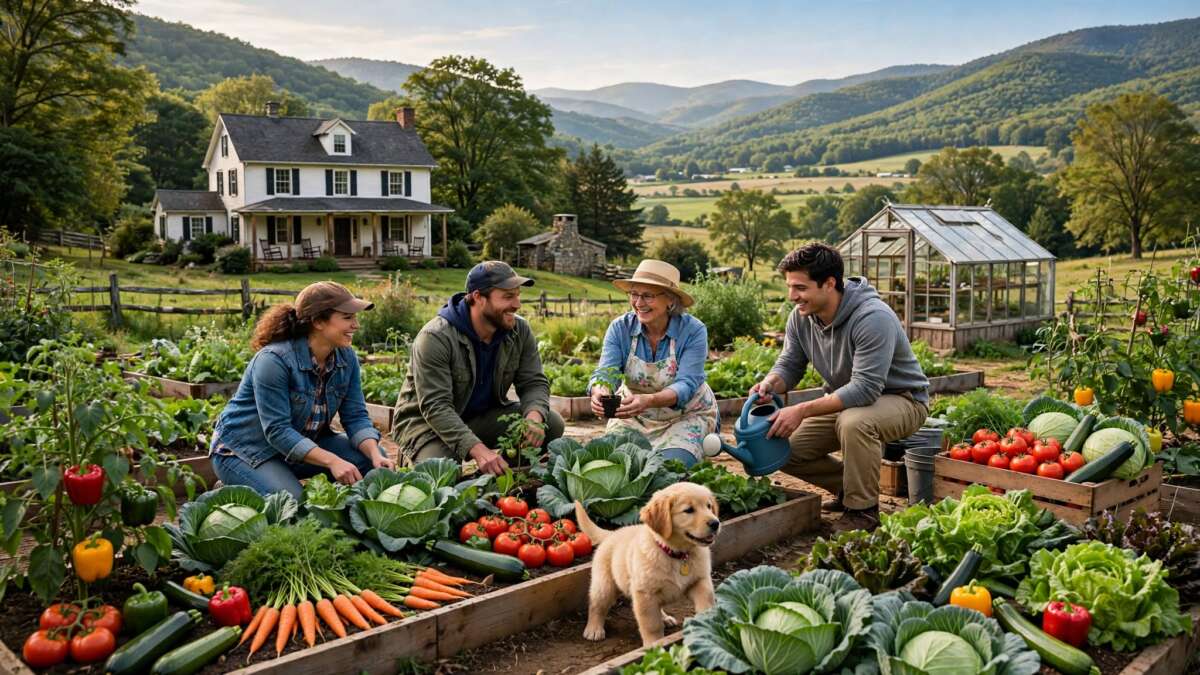
In the cool of the morning, Vern walked his property and thought about logistics. About three of his five acres were weed-infested open ground because the fire department had gone off the rails by year five and insisted that all property owners clear their lots of any vegetation they viewed as “fuel.” Then, by year eight, they didn’t even inspect anymore because just about any vegetated area left was burnt down to a crisp. The barren ground just contributed to the miserable radiated heat of the drought. Once the rainy years arrived, some nuisance weeds encroached on the disturbed soil, but nothing resembling a respectable cover crop emerged. Some enterprising landowners had taken to collecting native wildflower seeds and the seeds of larger indigenous brush species and yuccas and went about sowing them on their own, but establishing the former natural ground plain in settled areas was a slow go. Vern felt he could contribute at least three acres to cultivation, including the 1,000-square-foot garden that he and Mable had kept before she passed, and he lost all interest in letting it fall into disrepair. Perhaps Julie would cover it for the greenhouse she was planning to install. He saw another half-acre on sloping ground at the back of the lot where they could put in a kitchen orchard – apples, pears, peaches, plums – wouldn’t it be nice for him to be able to just pick them right off the tree, if he lived that long. Yeah, if he lived that long. Wouldn’t it be a shame if they did all that work and he just up and died on them, leaving them out in the cold? He decided to go ahead and do what he had been considering for over a year: change his will, leaving it all to Julie and Alex. He also instructed that he be composted. Alex would take good care of Weston; he had no doubt. They didn’t make them like Julie anymore. He was certain Mable would approve, and his kids would probably just fight over who got what and sell the place off quick just to rid themselves of the hassle. Now all that he had worked and struggled for would have a higher purpose. And he wasn’t dead yet, and some real excitement was coming his way. The saying about gardening amongst the locals was, “Don’t plant until after Mother’s Day.” That didn’t leave much time to get set up, and knowing Julie, this place would be a beehive of activity by the following weekend. Wouldn’t that be a sight?
Julie dropped by after church saying she wanted them to attend a lecture on Tuesday sponsored by the County Agricultural Cooperative Extension Service where an agronomist would explain the principles of regenerative agriculture. She was excited and did her little semi-dance again. This was going to be fun!
Vern couldn’t help thinking, Yeah, and if I were just forty years younger.
***
Tuesday’s meeting at the County’s Ag Extension Building’s meeting room started out with an air of disbelief fused with a good measure of unspoken hostility. The attendees were mainly farmers and ranchers from the Imperial and Coachella Valleys and surrounding areas. Most were middle-aged or older, obviously set in their ways, and most likely only here for the catered lunch. They sat slouched down in their chairs, arms crossed over their chests, with skepticism resting on their skewed noses. The agronomist started by asking them to consider how much debt they were in at that moment and to calculate how long it would be before they just couldn’t carry it anymore. A collective groan filled the room, and a few of them sat up a little straighter. Then the speaker said that if they were to survive into the next decade, they’d have to abandon their current methods and practices and adopt an entirely new paradigm. More groans, and a collective slouching back deeper into their chairs. The problem was the abused condition of their soil with the good news being that the solution was merely treating it differently which was to say much more intelligently and better.
Sustainable livestock management and regenerative agricultural practices could lead them out of this horrible debt cycle. Both were interdependent and both ultimately were dependent on the soil. In fact, scientists now believed that restoring soil health was the fastest way to mitigate the effects of global warming and most efficiently reverse its deleterious trends. No matter how you cut it, it all comes down to soil. Soil as the savior, if ever there is to be one. Soil. Soil. Soil.
Vern wasn’t surprised by this revelation. Back in his youth, the old timers talked incessantly about the Oklahoma Dust Bowl, and of how over-tilling of the soil year after year with no crop rotations or inputs of nutrient-rich soil amendments finally gave way to the catastrophes of the early thirties. John Steinbeck’s The Grapes of Wrath chronicled all the hardship the resource mismanagement caused. President Franklin Delano Roosevelt launched his alphabet agencies, including the Farm Service Agency (FSA) and the Civilian Conservation Corps (CCC), to name a few. Improved farming practices, coupled with tree windbreaks, slowly brought the region back. But then came the sixties and the Agricultural Revolution, often called the Green Revolution, which initially staved off world hunger but eventually hastened the utter devastation of the world’s topsoil supply. Then the corporations took over farming in America, driving the family farmers into the cities, and factory farming practices, with their massive inputs of chemical fertilisers and chemical pest controls, drove the final nail in the coffin of the planet’s precious topsoil. Today, over 70% of it is gone – dried up, blown away, lost forever. It can’t be recovered, but it can be rebuilt and better managed once it is. Vern knew the quickest answer to the world’s soil problem and was surprised that most of the brilliant minds in that room didn’t seem to.
***
They could talk about all the soil restoration methods that they wanted to, but one fact remained: that if every farmer and rancher in the entire world was convinced to utilize sustainable practices today, they in and of themselves, still wouldn’t be enough to cover the Earth’s depleted soils with enough productive vegetation in time to ward off the next wave of climate change-driven droughts. Something has to speed up the process, and that something is compost derived from organic matter, which, as much as everyone seems not to want to admit it, could most easily come from the bodies of deceased humans. Nutrient-rich compost, infused with its biggest allies, earthworms, would immediately increase moisture absorption rates and encourage the fastest-growing cover crops to take hold. They could stabilize what’s left of the soils so that then more desirable species of vegetation and food crops with wider spreading and deeper penetrating root systems could be rotated in utilizing seed drilling methodologies.
Since the first human who stuck the first plow into the Earth, the planet has been losing soil due to nutrient depletion, chemical poisoning, and ultimately wind and water erosion. Eventually it becomes nothing more than dust that blows away or playas of impenetrable caked ground. Humanity then abandons it and moves on with a mentality similar to slash-and-burn planting in the tropics, or forces it to produce beyond its natural capacity with massive applications of chelated fertilisers that not only further poison the soil but also poison the water supply. Mankind’s addiction to the extractive-industry mentality has led it to the brink of ruin. Exploit a resource until it is entirely used up and then go looking for another one to use up; the most pathetic example being our worship of fossil fuels even though we know that this is a finite, nonrecyclable resource that, when it’s gone – it’s gone. But until that day…why worry?
We Homo sapiens did this to ourselves, and our species will have to undo this ourselves by getting real about human composting, yet it costs over ten grand to bury our loved ones in resource-squandering coffins and hold expensive “celebration of a life” events which are oxymoronic in the extreme because the person is already dead – dead as a doornail. The only useful thing they could possibly do now is give their body back to Mother Earth. Ditto for livestock and pets that die of natural causes. We are facing a crisis, and desperate times call for desperate measures. Every creature that took anything from the Earth should now be required to give it back.
***
At daybreak Saturday morning, Vern was awakened by the slamming of car and truck doors. Excited, joyful voices wafted into his bedroom. Julie’s voice rose above the rest and assumed total command. Vern hurriedly dressed and went out with Weston to the front porch. People were scurrying in all directions. Julie was spray-painting the layout of the various garden areas on the ground. Even Spencer and some of the younger men were snapping to it. The greenhouse frame was already being erected over the old garden just like he had expected. Massive amounts of compost lay in the beds of three dump trucks waiting to be spread. Things were happening.
Julie came up to him asking, “Want to inspect?”
“Did you leave me room to park my car and get into my house?”
“Of course, Vern.”
“Then no, no, I don’t. I can see that you have everything handled.”
She smiled that mesmerising smile of hers, the one that made him feel wanted and important, and then she quickly melted into the hubbub once again, assuming total command. What a gal!
Alex peeled off from a group of young people who were unloading bags of potting soil and sundry equipment and ran up to him, saying, “Sorry, Vern, I’ve got to work. But can I take Weston for a walk later?” He was gone before he had the answer and Weston’s jerking on his leash let Vern know that he wanted the walk right now, but he would have to wait until sunset. This was going to be a sunup-to-sundown affair, just like farming in the old days.
Mike Mitchell came up and unfolded a deck chair, telling Vern, “Take a load off, buddy. This is a real good thing you’re doing. I’m proud to be your neighbor.”
Vern sat back and took it all in. This land would live again, and it was destined to thrive. Crops and other vegetation would cover the soil and shield it from the sun’s drying rays. They would perform the miracle of photosynthesis, sending airborne carbon back into the ground to be sequestered while also transpiring moisture that would raise humidity and encourage rain to fall; when it did, their root systems would quickly absorb it, preventing erosion. If enough landowners, farmers, ranchers, and concerned citizens worldwide were to follow this example the Earth would be shrouded with the wonderful plants and then stabilize and slowly cool. The soil that humanity had abused with impunity for centuries would now, with a little care and nurturing, save humanity from its own death wish. Mother Earth would welcome her children back home again, and those children, now wise from the lessons of regenerative agriculture, would know the best way to stop any future drought was to never let one start again.
This community garden was going to be exactly the cure for what ailed him. Vern felt more connected to the overall community now. He felt like he mattered and that he actually made a difference. Alex and his little friends looked up to him, and it had been a very long time since anyone had done that. The agricultural greening and natural revegetation of the valley could help combat the forces of climate change. The past summer had actually been cooler than the previous twelve summers, each successive one hotter than the last. Finally a respite, a reversal in fortunes, a gift from God? Maybe, but Vern harboured doubts, feeling that many people, his neighbours among them, were simply grateful for the reprieve and not at all cognizant of why it had occurred. If human history was any indicator of what to expect in the future, he would be disappointed in his brethren for returning to their extractive, wasteful ways. But if some folks actually did change due to the hard lessons they had learned in surviving and rebounding from the drought, then there could be a better future as the Earth repaired itself and the next generation coming up adopted a new paradigm for their ongoing survival; that being to let Mother Earth do her work on her own time frame, and to never try to hurry that along. The lesson was clear: the more mankind tries to tweak Mother Nature, the more she comes right back around to prove that she had a better plan all along.
Author’s note: I decided to run this piece today because California is once again burning; the trend since 2015 has been that every new year is hotter than the last. We have had eleven consecutive years of this and yet the climate change deniers, big oil, and the Orange Fuhrer still call climate change a hoax. Believe what your own eyes and your skin are telling you. I have addressed all this, and our dwindling window of time to do something impactful about it in: Our Environmental Awakening: A Brief Guide to Surviving Climate Change which I am running here on Substack in serialization of five three-chapter segments over the next five months. The glossary and bibliography are freely available on this site, while chapters 1, 2, and 3 are available with a paid subscription.
Earlier, I reached out to whatever readership I may have and asked this specific question:
Agree or disagree?
1). Show, don’t tell. All the writing books, every professor of literature, every editor, and every literary agent on the planet love to say this, and on some levels it’s good advice. However, I will ask you: when was the last time someone told you, “Show me a story?” So it’s a pet saying wheeled out by those who don’t want to take the time to thoroughly critique anything put in front of them. This business has devolved into a pathetic imitation of a speed-dating session, where candidates are encouraged to reject one another based on the flimsiest assumptions and move on as fast as humanly possible. In the writing trades, that most often happens at the query letter phase, and if an author navigates that paper Strait of Hormuz, they often get blown out of the water before the end of the first paragraph. An offshoot of this fatwa is the ever-popular term of “info-dumping”, which is viewed as a close cousin to a flesh-eating disease in the literary world. Or it’s, “Don’t let the message get in front of the story,” which makes me wonder why write anything at all to get your message across, even if it’s good enough advice to save the entire planet? So, where do I deliver my message? Most would say, “In a nonfiction piece where it belongs,” and I say, “Who made that ridiculous rule?” I feel that if you want your message to be received by those who aren’t necessarily looking for it but who would greatly benefit from somehow absorbing it, then you better find a way to make it interesting; and encased in a good piece of fiction is the easiest way to do that.