

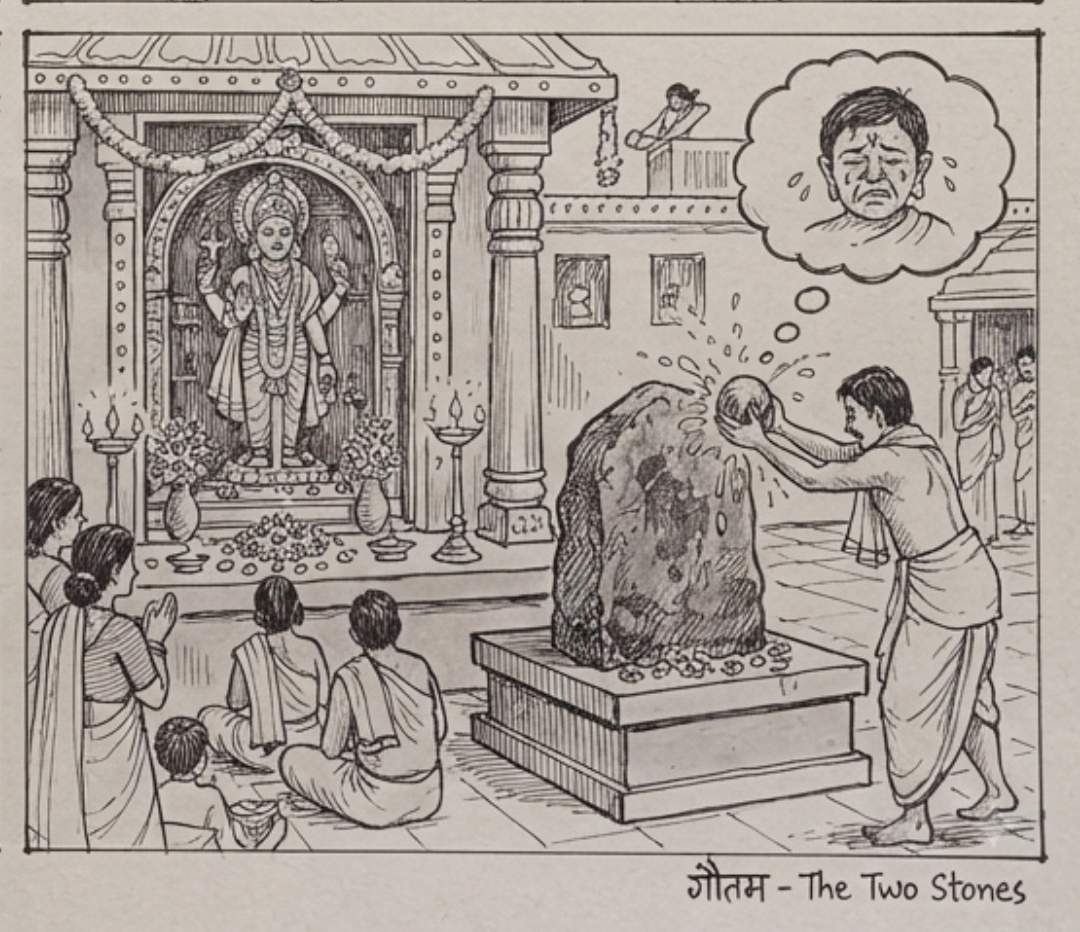

Little Nirmal sat on the wooden veranda, nursing a stinging palm and a bruised sense of justice. It was a grievance common to childhood, sharp and absolute. “Be it sports, studies, singing, or dancing, why do teachers punish so much?” he muttered into the afternoon dust, rubbing his knuckles where the village schoolmaster’s rattan had recently left its warm, indignant mark.
His mother, sitting nearby on a low stool with a basket of split betel nuts, paused her work. She looked at him with that quiet, timeless knowing mothers seem to inherit from the earth itself, and smiled a slow, curving smile.
“Ah,” she said, her voice dropping into the cadence of an old evening raga. “Let me tell you a story about a sculptor.”
***
Long ago, in a valley where the shadows of the hills lengthened like old men stretching their legs, there lived a sculptor. He was a man of infinite patience, though he possessed the stubborn habit of talking to his materials. His life was spent in a quiet dialogue with the earth, a relentless search for the right rocks—stones that possessed a hidden soul, waiting to be coaxed out into the light.
One morning, he trudged up the winding mountain path and hoisted a heavy, stubborn chunk of granite onto his shoulder. Dragging it back to his dusty courtyard, he picked up his hammer and chisel. The morning air was crisp, smelling of pine and damp moss. He placed the iron point against the grey flank of the stone and struck. *Tink.*
The iron bit deep. But before the dust could even settle into the creases of his palms, a strange thing happened. From the heart of the stone came a low, shuddering gasp, followed by a muffled, pathetic sob.
The sculptor dropped his tools in astonishment. The unfinished idol was crying with pain.
Great, salty drops of moisture leaked from the fresh cleavage in the rock, turning the stone grey to a bruised purple. “It hurts!” the stone wailed, its voice grating like grinding gravel. “Your iron is cold, your mallet is heavy, and every strike feels as though my very bones are splintering apart! Please, spare me. Let me be.”
The sculptor stared at his hands, then at the weeping block. A wave of profound, artist’s melancholy washed over him. He was a creator, not a torturer. With a heavy sigh of defeat, he laid down his instruments, pushed the sobbing block into a neglected corner behind the overgrown ferns, and abandoned the dream of that particular face.
***
Days passed, and the mountains called to him again. The sculptor returned to the high ridges, his spirit chastened, and brought back a second piece of stone—rough, unassuming, and weathered by centuries of rain.
He set it upon his wooden block and took up his chisel once more.
Tink. Tink. Tap.
The iron bit into the flank. Chips of grey stone flew like startled sparrows into the afternoon sun. The sculptor watched the stone closely, bracing himself for the tears. But the stone remained completely silent. Not a whimper, not a sigh, not even a sympathetic shiver disturbed its stoic surface.
Curiosity finally broke the sculptor’s concentration. He lowered his mallet and wiped the sweat from his brow.
“Do you not feel any pain?” he asked, tilting his head. “You aren’t saying anything at all.”
The stone slowly opened its imaginary eyes—or perhaps it was just the wind whistling through the freshly carved ears—and replied with a calm, resonant gravity.
“Of course there is pain,” the stone whispered, its voice steady beneath the blows. “Your iron is harsh, and the cutting edge is merciless. But I know what you are doing. You carve the stone to create a magnificent statue; there is indeed temporary pain, but the resulting form will soon stand in a place of honour, bringing joy and wonder to countless people.”
The sculptor smiled. His heart swelled. He worked with renewed vigour, chipping away the excess until a divine grace emerged from the rough matrix, smiling serenely into the quiet courtyard.
***
Years slipped by like leaves drifting down a lazy stream. One afternoon, the local king, resplendent in silks and surrounded by clattering horses and fluttering banners, went out on an inspection tour of the countryside. Passing by the sculptor’s courtyard, his royal gaze fell upon the magnificent finished statue.
He stopped his procession. He gasped at its beauty. Without a second thought, the king declared that it must be taken immediately to grace the sanctum of his newly built grand temple.
As his guards carefully hoisted the glorious idol, the king’s eye caught the old, moss-covered lump of granite sitting neglected in the corner—the very first stone that had cried out and refused the chisel.
“And that one,” the king commanded, pointing a jewelled finger. “Let us take that along too.”
The sculptor stepped forward, bowing low. “Your Majesty, that stone was never carved into a statue; it rejected the work. What on earth will you do with it?”
The king laughed, a rich, booming sound that echoed off the hills. “Oh, do not worry about its artistic merits! We shall take it along to the temple courtyard. It will serve the humble, indispensable purpose of breaking coconuts.”
***
Nirmal’s mother paused her storytelling. She picked up a dry betel nut, placed it on a small iron anvil, and struck it cleanly with a heavy brass nut-cracker. Crack.
She looked down at her son, whose initial anger had melted into a thoughtful, wide-eyed silence.
“You see, my little one,” she said gently, her eyes twinkling with a touch of affectionate irony, “upon noticing that strange little anecdote, the wise sculptor reflected on the fate of his materials.”
She leaned in closer, dropping her voice to a conspiratorial whisper. “The stone that endured the temporary pain of being carved became a sacred statue, anointed with sandalwood paste and worshipped by kings. But the stone that could not withstand that pain—the one that wanted only comfort and ease—is now destined to endure nothing but suffering forever.”
Nirmal blinked. “Forever?”
“Oh, yes,” she nodded solemnly, though the corners of her mouth twitched with suppressed amusement. “For instead of reposing in the cool shade of a temple sanctuary, it is now subjected to the repeated, forceful, and thoroughly unromantic blows of hard-shelled coconuts, crashing against its head from dawn until dusk.”
Nirmal looked down at his stinging palm. He thought of the schoolmaster’s rattan, the endless multiplication tables, and the gruelling steps of the classical dance class. He slowly rubbed his hand, a wry, self-deprecating little grin creeping onto his face as the heavy thud of an imaginary coconut echoed faintly in the afternoon heat.

































The famous quote of Einstein is, “If you want your children to be intelligent, read them fairy tales. If you want them to be more intelligent, read them more fairy tales.”