
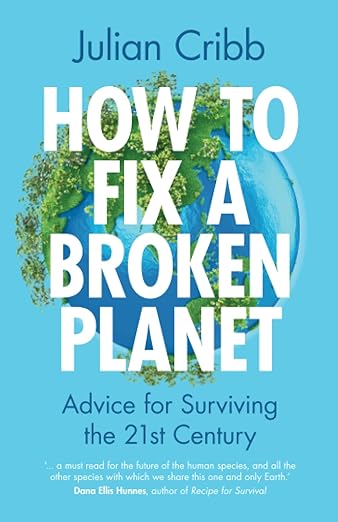

Author: Julian Cribb
Publisher: Cambridge University Press. Cambridge, UK.
Print length: 218 pp
Price: $17.99
Australian journalist Julian Cribb is providing a major service to the family of man with this important book. Unlike the standard fare of doom-and-gloom climate change and pending environmental catastrophe books, there is a certain measure of idealism and positivity contained within these pages. Not that Cribb has his head in the clouds, as he is, above all, a realist who lays out in graphic detail the scope of the problems facing Homo sapiens, humanity, us. But he then delves into solutions and the pathways to take to achieve them, before explaining what actions any given individual can take to aid in that process. In short, for the first time in a very long time this is a book that delivers on the premise of its title. Not that it won’t take work, but for those willing to indulge in it the rewards can be plentiful.
The research effort is impressive with 275 works cited, but it’s the out-of-the-box thinking that is truly impressive. Cribb states his purpose for writing this book in its Preface:
Many people, especially the young, say they feel a sense of hopelessness when they contemplate the sheer scale of the task of fixing global problems as massive as climate change, global poisoning, pandemics, or nuclear war.
The antidote to hopelessness is action. This book is all about action (p. ix).
Like all climate change books, homage is paid to the scale of this existential threat and an explanation as to why some have a vested interest in downplaying it:
The danger is exacerbated by widespread delusion about the scale of the challenges we face, fierce competition over dwindling resources, our pride, and our warlike tendencies (p. 5).
There is widespread delusion, denial, and failure to recognize the reality of our plight. Misinformation is being actively spread by a misguided or malevolent segment of humanity (p. 6).
Unlike most climate change books, Cribb warns of future pandemics being more plentiful with one reason being that with a 70% loss in the population numbers of all animal species that still remain on Earth (with the exception of Homo sapiens) since the 1970’s, these nefarious microbes have little choice but to hop from their traditional animal targets to humans. This should not be surprising when you consider that humans are indeed just another species of animal, despite the fact that many amongst us feel that we are a higher form of life.
In December 2019, a cluster of 41 cases of a mystery infection was detected in Wuhan, China. In less than two years, the novel plague blazed around the Earth, infecting over 500 million and killing 15 million of them.
Nobody should have been surprised. Since 2000, there have been seven new pandemics – epidemic diseases that spread internationally – SARS, swine flu (H1N1), MERS, Ebola, Zika virus, Covid 19, and monkeypox. Meanwhile, the HIV/AIDS pandemic, which began in the 1970s, continues to rage, claiming over 40 million fatalities worldwide. In all, these biological ambushes may have taken the lives of as many as 50 million humans, or more, since the start of the present century, putting them on a par with the two world wars for sheer deadliness (p. 79).
Then the author hits at the heart of the matter, the basic truth as to why our planet is really in the grave trouble that it is:
When superficial factors are stripped away, however, the principal driver of today’s pandemics is human overpopulation – an unpalatable truth which government and UN officials are reluctant to voice out loud (p. 81).
News flash, everyone: the rampant expansion of our species is the primary culprit for all of Earth’s multitude of environmental problems. We are now running at north of 8 billion individuals while most experts put a sustainable number of us at 2 billion. No matter how you cut it, to save our species on this planet there has to be a drastic reduction in our numbers. Herein lies the rub: this can be achieved logically through the joint cooperation of the family of man, or it will be foisted upon us in the form of mass starvation, wars over resources, and the aforementioned pandemics, but have no doubt about it, the reckoning is coming, and one way or the other, something’s got to give.
All of which brings us to Cribb’s “one child fewer” proposal:
The single best way to reduce overpopulation voluntarily is through family planning – and by individuals taking a voluntary decision to have fewer babies, or even none at all (p. 110).
The evidence shows conclusively that developing countries with low or falling birth rates have the strongest rates of economic growth – while those with rising populations struggle to escape the poverty trap (p. 111).
Unlike a lot of books in the environmental “climate change” genre, the author devotes an entire chapter about all of the chemical poisoning that is occurring on every part of our planet:
Recent assessments have identified more than 350,000 man-made chemicals in existence. The US Department of Health estimates that up to 2,000 new chemicals are being released every year. The UN Environment Programme (UNEP) warns that most of these have never been screened for human health or safety. In all, more than 2.7 billion tonnes of industrially produced chemicals are manufactured each year, and sales are forecast to double by 2030 (p. 70 – 71).
On a typical day, more than 25,000 people die from poisoning or diseases caused by their chemical environment (p. 71).
Concerning the recent rise of the restorative agricultural movement that is getting a lot of lip service and air play Cribb proposes an international program that can monitor its impact and quite possibly guarantee its success:
With corporate agribusiness currently throwing hundreds of millions of small farmers off their land and replacing them with unsustainable industrial food systems, the need to retain their skills, knowledge, and love of country for restoration of the planet is urgent. A Stewarts of the Earth programme will create a skilled workforce on the spot, for environmental repair and restoration, prevention of extinction, and prevention of new pandemic diseases as global food production moves progressively into cities and the deep oceans. Its aim is to restore and rewild the global natural environment so that it can sustain all of our civilisation together with the Earth’s existing biodiversity far into the future (p. 99).
Towards the end of his book, Julian Cribb asks the question that so many great environmental authors have asked and will continue to pose to the family of man, a question that calls for a brutally honest self-assessment in a chapter entitled: “Who Are We Really?” He kicks off the chapter with a quick rundown of all the usual suspects:
When we study how modern humans behave, we see that it is anything but wise. We have wiped out two-thirds of the world’s large animals. We are losing water, topsoil, fish, and forests at appalling rates. Every day we poison everyone and everything on the planet. We are constructing weapons able to obliterate us many times over. We are shaping a climate that can render the Earth largely uninhabitable within the next three or four generations. We are building clever devices over which society has no control, but which can decide our future. We throw half of our food away and wreck the planet trying to grow more. We unleash new plagues every few years and spread them worldwide like wildfire. Are any of these the acts of a wise or even an intelligent species (p.137)?
Later in this chapter, Cribb poses eight questions that I personally feel constitute the beating heart of this book – at least for those introspective and concerned enough to answer them truthfully:
- Have we eliminated weapons of mass destruction? How close are we to doing so?
- Are we reversing climate change by using fossil fuels and returning forests?
- Are we ending our poisoning of the planet, by eliminating waste and replacing toxic chemistry with green chemistry?
- Are we taking real steps to end the Sixth Extinction by rewilding the planet?
- Are we putting wise women in leadership positions globally and heeding their advice?
- Are we taking universal steps to lower human numbers voluntarily?
- Are we recycling all minerals, nutrients, and water in a circular economy?
- Is society taking oversight and ethical control of dangerous technologies like nanotechnology, AI, and quantum computing (p.139 -140)?
The fifth question is particularly illuminating because it speaks to the genetic hardwiring inherent in our species. For men, that’s the fight-or-flight mechanism, and for women it’s the nurturing maternal instinct to protect the young at all costs. There’s a bedrock of veracity in this question if you consider that every mass shooting in America has been conducted by a man with the exception of one, and she identified as a man. Let that sink in, and you will know why there is such a term as “toxic masculinity.”
The eighth question also strikes at the heart of the issue as to why more urgent action is not being taken, and the answer is simple: profit above all reasonable considerations for our mutual survival. When the AI bros all show up at the most recent G7 and are widely accepted and embraced, that should tell you all you need to know about what really rules – money, or as The Who so poignantly sang, “Meet the new boss, same as the old boss.” These are the very same guys who warn of the dangers of AI while at the same time insatiably driving it ever onward. In other words, the inmates are running the asylum. In allowing them to rule the roost, the question must be asked: have we gone mad or what?
Probably the most innovative of the author’s proposed actions lies in suggesting a universal monetary system where the value of currency is based and backed by the health of any given nation’s environmental systems and sustainable maintenance of its natural resources. Since the concept of monetary wealth is an invention of the human imagination, why not imagine something that matters to the ultimate survival of the family of man?
The Earth Standard Currency, the value of which is based on actual assets, physical and ecological, for sustaining life on Earth meets such a need (p.145).
English naturalist Sir David Attenborough is famed for his statement that ‘Anyone who thinks that you can have infinite growth in a finite environment is either a madman or an economist (p. 150).’
Cribb suggests that we not elect leaders the world over who do not concern themselves with these urgent environmental issues which seems logical enough except that there isn’t much we can do when such leaders are not offered up with the exception of not voting at all which is personally a nonstarter. When so frequently presented with the best worst option there is little recourse except to vote them in and just as quickly vote them out when they fail to do what few positive things they promise to do, or more frequently fail to do anything at all but enrich themselves.
I do deeply admire the author’s altruism and empathy drawn from his position as a father and grandfather, who as a boomer, knows what I know; that being that we will probably arrive at the finish line relatively unscathed. But we love our progeny, and as a species no better and no worse than all the other species who share this Earth with us, we have the same instinctual drive deeply embedded with our psyches – survival of the species. That’s why he and I do what we do – for the sake of the grandchildren. And when I look at a guy like Donald J. Trump, or Putin, or Ce, or little rocket man, I feel disgust for the greed and self-absorption of my own species. Thankfully, we aren’t all like that and it is in us where the fate of Mother Earth lies. I want to contribute by doing my part because I’m not dead yet, nor is the author.
As a highly motivated grandfather, I highly suspect that Julian Cribb is sacrificing part of his royalty in favour of getting the word out to as many people as possible. This book is very reasonably priced and contains more creative and useful information than other climate change books costing nearly twice as much. I hope that it falls into the hands of every Gen Z’er on the planet because, let’s face it, the Earth is theirs to inherit (or not).
The author delivers his final plea couched as a warning on the last page of this noteworthy book:
We humans will become simply another failed evolutionary experiment that lingered for a while – and then, thoughtlessly, engineered our own departure because we lacked the wisdom to avoid it (p. 168).
If this were Amazon, I’d give this book five stars, but since it is not, I’ll just say that I rank it in the top three in environmental titles released in this new millennium. Well worth the money. And now it goes to the community bookcase at our local post office to be picked up by anyone or perhaps someone destined to become the next environmental prophet. I certainly wish it well and Godspeed.