

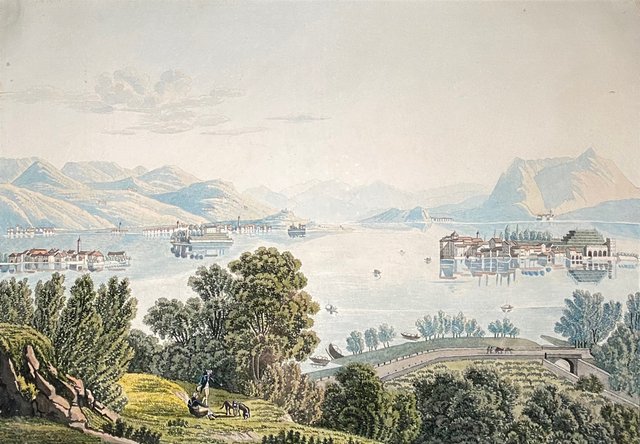
The trunk of that great tree separated us from our husbands. They sailed on the canoe, and we could hear their laughter.
The sun beamed; the lake glittered. Yet all I could see was you and the textured background of bark. It had an earthy smell which, when interweaved with your perfume, made my nostrils feel like tumbleweeds in Eden.
Azaleas surrounded us. Their vibrant colour convinced me that we were in a hidden paradise: that we had discovered a scenic utopia. I embroidered them onto the linen to remember the occasion, to remember you.
I felt a dull pricking whenever I pushed the needle’s tip through the cloth, a constant reminder that I was experiencing reality.
Didn’t you know how perfect it was? Hidden in the shade of the leaves. Each Sunday, the Reverend’s voice, which echoed against the walls of the church — as commanding as the Lord’s itself – would speak against the shadows. It may be blasphemous to admit, but it was those moments in the shadows which I longed for the most. In the shadows, I could be with you.
My arm absorbed the warmth of your grasp as you clung onto me, “What are you embroidering?” you asked.
Everything seemed so perfect that the blades of grass around us weaved amongst one another. As they rustled in the wind, they whispered their support for our joyous activity. You embroidered beside me.
My hands might have been embroidering, yet it was yours that embroidered the joy into my heart. You told me you had the same idea for your linen, and both our eyes were upon the azaleas.
If only I knew then what I do now. What I saw as harmony, you saw as a competition.
“Why,” you said as you leaned closer to my work. You pointed your finger at a specific stitch, “It is a shame that it is a little wonky there.”
I didn’t mind the criticism; if anything, I took it as a compliment. How intertwined with someone must you feel to give your honest opinion? You had become so comfortable around me you knew I could never take it as an insult. It was as though the lobes in our brains had been embroidered together.
I knew we were both married, and I know lust is a sin. I repented for it then, and now I repent for it a great deal more, knowing my feelings weren’t reciprocated. You never loved your husband; you told me so. I hadn’t loved mine either for my love was placed aside for you; yours was non-existent.
I remember the moment it all changed. When I saw your true intentions. We were in your drawing room, embroidering beside each other. We sat on the Chesterfield sofa, and I longed to embroider the border of your shadow.
Tea was on the mahogany table, and sandwiches too. We paid no attention to them; we were too busy enjoying each other’s company. You slipped the words while I slipped the needle.
“I’m glad men don’t favour linen, for I could never love someone with whom I shared the same passion. I am far too competitive for that.”
You said it so casually; your work was on your lap as you inspected your nails. As your admirer, I was crushed, though it was the title of being your dear friend that caused the bulk of my despair. Upon further reflection of your statement, I realised that you had never cared about me at all. Not romantically, not platonically.
You had shown such a deep interest in me and my work. I was a fool to have thought it meant something. It was not affection; you criticised me because you longed to be better. Most of the time, you were too. Your embroidery was always so intricate in comparison to my sloppy work. Though on the rare occasion when I had the upper hand, you couldn’t stand it. I see that now.
I wish I could explain the conflict that you had created within me. At first, I hated myself for my passion. Why did it have to be embroidery? If I were an artist or perhaps a chef, you could return my affections to some degree. Maybe then you wouldn’t have seen me as a threat but as a lover.
Yet to stop embroidering would be to reject my own identity. Is it better to be loved as a false self, or not to be loved at all? It didn’t matter anymore. You destroyed years of affection in a single sentence.
Your words still plagued my mind as I slept in the cold bed, as I slept beside him. When I didn’t face him, I could be convinced that I was lying beside a slab of meat from the butchers. He was beef. When he changed positions and his leg moved against mine, it was as though his raw juice had infiltrated my veins. When the love I once had disappears for someone, the thought of touching them becomes abhorrent. He sickened me.
In that bed my mind turned to you, my dear. As I lay beside him, your sins no longer seemed half as bad as what they had once done. Know that if you returned my feelings, and I had to sacrifice my passion for your love, I would. I wouldn’t have to think about it. Though I couldn’t give it up because of your hatred.
There wasn’t any confirmation that you could have ever returned the feelings. Even if you did, it wouldn’t have been me that you cared for. It would have been your triumph over me.
In that regard, you sickened me as much as my husband did. Yet I still longed for your touch. I longed to spend every waking hour with you. It was unnatural, it was unhealthy. I knew I couldn’t continue this way. I had read Macbeth one too many times to know I didn’t want his fate.
I couldn’t look at you again, for you would be my ruin. In fact, I couldn’t bear to look at anything. The night was a temporary aid. Yet the sun would always come back, a cruel medicine for my eyes. That’s when the idea came to me. I weighed out the pros and cons and decided that to remove one of my senses was better than to lose all five to you.
My day began when he rose from the bed. I would never have to see him again, thank God. I would do it quickly; it would be over by noon. The solution lay in my bedside drawer: it had been my solution to most things. The embroidery kit. I threaded the needle and unravelled the string. If only I could have similarly unravelled my heart. If only I could have extracted my feelings for you and hidden them under a floorboard. Then I wouldn’t have had to go through with it.
There was no point in using a mirror for the first eye, for I wouldn’t be able to with the second. I trusted my abilities.
I tugged my eyelids away from my face. They felt thinner than what I previously remembered, like the wings of a butterfly. Do you know that when you hold a butterfly’s wings, their colour stains your fingers? My tears stained mine. On the first stitch my eyes convulsed backwards with pain; one scratched against the start of the thread. I had never screeched so loud before. As it passed through, each stitch created felt like ten thousand thorns pricking at my sockets. An eternal set of lashes stuck within me.
The pain was unimaginable. My mouth opened, my vocal cords screamed, and I heard a banging from the door which I had locked. Yet it wasn’t me doing the embroidering, or at least it didn’t feel like it. I was hidden somewhere behind my own stitches, trying to pinpoint my own suffering further. The needle was the serpent; my eyes were the branches of the knowledge tree that it weaved through. You were Eve. You had ruined me. I gave you the power to change me forever. You ruined me.
I sobbed when it was over; the tears struggled to escape.
The coachman had to guide me to your front door. I asked him to leave me alone; he didn’t need any reassurance. I heard his hasty steps as he left.
When you opened the door, you leaned into me and whispered about what a terrible job I had done. I felt the heat of your smile radiate into my ear. The stitches on my eyes were uneven, and I’d never see them. You said my embroidery would worsen with my lack of vision.
You kissed me, then closed the door. I struggled to find my way back to the carriage.