


“Eureka!”
An exclamation of triumph reverberates through the empty library of the Asiatic Society in Park Street. The whitewashed walls glare back in silence, reprimanding the speaker for shouting in a place where whispering is the norm.
The speaker blushes momentarily for his sudden outburst, looking around hurriedly to see if anyone else witnessed his lapse in judgment. He takes out his notebook and scribbles down details from the open page of the manuscript he’d been reading for the last few hours. The manuscript is ancient, dating back to the pre-colonial era, and special permission was required to access it. Its pages are ancient and worn out, but most of its text is still legible.
Once the writing is complete, the speaker of the triumphant exclamation hands over the book to the security guard outside and heads for the exit. He calls a cab and gets into the back seat, directing the driver to head towards Ballygunge. As he glances at his watch, he finds that it’s almost 6 PM.
His name is Swapno. He’s in his mid-30s and is an assistant professor of botany at a reputed government college in Kolkata. His research focuses mainly on medicinal plants and their applications. Today, he stumbled upon an ancient manuscript hidden inside a glass cabinet in a corner of the Asiatic Society’s library. Through the dust-filled glass, the label was barely visible – Regional Plants and Herbs with High Medicinal Values. The author’s name had faded into obscurity. After obtaining the necessary permission to access the book, Swapno had spent the better part of two hours studying it. It contained the accounts of a British traveller who had spent a significant portion of his life in West Bengal in search of medicinal plants.
While most of the plants mentioned in the book were familiar to Swapno, a single passage near the end stood out and caught his attention.
The author described the leaves of a strange shrub he found among one of the indigenous tribes of the Sunderbans. They introduced it to him as kalagulma – a shrub that, according to the tribespeople, possessed miraculous medicinal properties. There was no malady that it could not cure, no illness that it could not overcome.
When the author asked the tribespeople where this kalagulma was found, they gave him the location of a distant, uninhabited island of the region and warned him that the plant extracted a heavy toll on anyone bold enough to seek it. There was a description of the shrub and a rough location of the island where it was supposedly found. This information had prompted Swapno to shout with joy, and he had written down all the details, already thrilled by the scent of an adventure.
As his cab weaves through traffic, he sits in the back seat – notebook in hand – re-reading his notes. The kalagulma is a small shrub with short, pointed leaves resembling a trident. White veins run through the foliage, making the plant stand out against its surroundings. Being evergreen, it is found throughout the year.
“Kalagulma,” Swapno mumbles under his breath.
“As far as I understand, kala translates to black, and gulma to shrub. But why is it called kala? Based on the description provided, nothing about the plant is black. There must be some mystery here!” he mutters to himself.
By the time he reaches home, it’s 7 PM, and he’s made up his mind to set out in search of the kalagulma this coming weekend. His parents are surprised to see the look of exuberance on his face as he storms into the living room, panting and out of breath.
“Mom! Pack my bags! I’m going to the Sunderbans this Saturday,” he declares triumphantly without wasting a minute.
Seeing the look of surprise in his parents’ faces, he sits down on a sofa and tells them everything that happened in the library.
“Are you sure it will be safe?” His mother is the first to speak. A mother’s worries know no bounds.
“Of course! Don’t worry about anything. I’ll be fine,” assures Swapno in a confident voice.
“Well, if you must go, you should at least take some warm clothes with you. It’s quite cold in the Sundarbans in November,” his father suggests.
“Yes, yes! Give me anything you want,” Swapno exclaims, happy that his father has responded positively.
Two days have passed, and it is a cold Saturday morning. It is barely 6 AM, but Swapno is already getting ready to leave. He’s fixed a car that’ll take him to Godkhali, from where he’ll take a boat to the island of the kalagulma.
“Bye! Wish me luck!” He screams to his parents from the back seat of the silver hatchback that starts speeding towards its destination 90 kilometres away. His parents wave him off, praying to God that their son returns home unscathed.
By the time he reaches Godkhali, the sun is up, and the weather is quite comfortable. Swapno soaks in the warmth of sunlight flooding the earth. It takes him around 10 minutes to find the boat that’s supposed to ferry him to his destination.
However, he learns a disturbing fact when he describes his destination to the boatman.
According to the boatman, no one goes to the island that Swapno is talking about. Even animals and birds steer clear of that piece of land. There’s an old legend surrounding that place – it’s said to hold primordial secrets powerful enough to change a person forever. The rumours have been around for centuries, keeping even the bravest of their people from setting foot on it.
But Swapno has made up his mind. He has not travelled 90-odd kilometres just to be deterred by some urban legends. He’ll go to the island, by hook or by crook. Seeing his unwavering determination, the boatman finally gives in, but he’ll only take Swapno there under one condition.
“My boat will be waiting for you near the shore for three hours. If you don’t come back by then, I will not hesitate to leave you and come back. I hope you understand,” he says firmly.
“That’s more than enough,” Swapno replies, elated at the boatman’s decision.
They set sail across the tranquil waters of the Bidya – a quiet tributary of the sacred Ganges – which ultimately flows into the Bay of Bengal. As the island of legend grows nearer, Swapno’s excitement increases exponentially.
By the time the island comes into view, it is around 11 AM.
“Look, there it is,” exclaims the boatman, pointing his finger at the tiny mass of land that has appeared near the horizon.
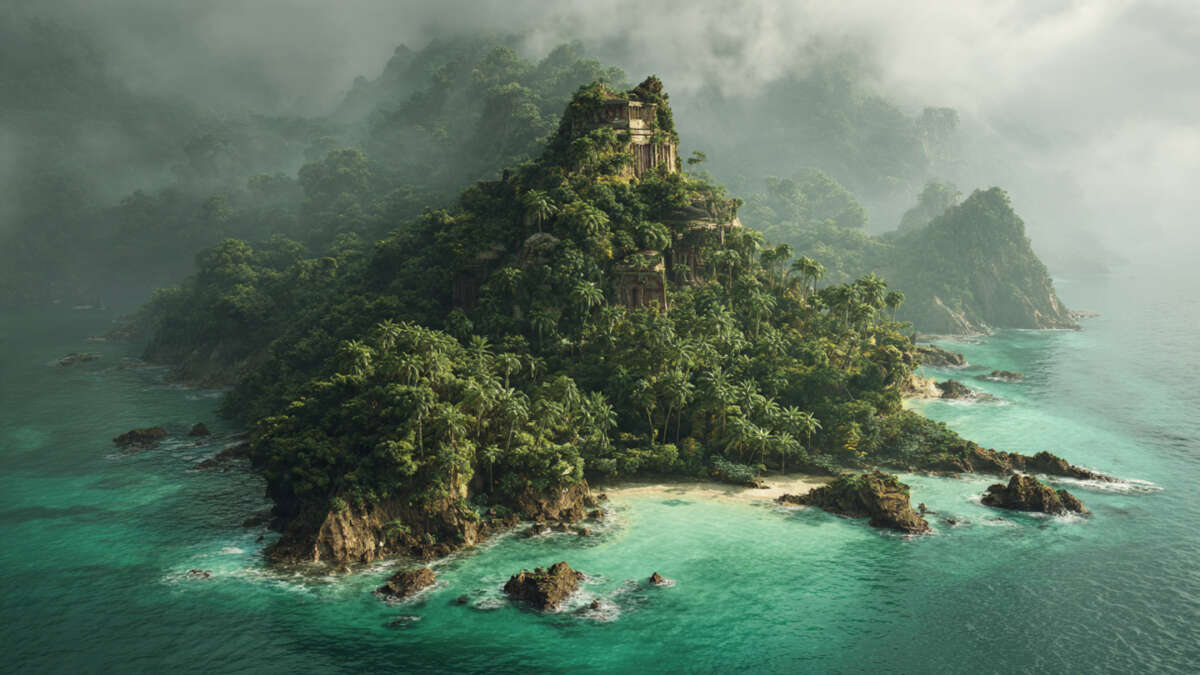
As they get closer, the island feels increasingly ominous – shrouded in dense vegetation that has enjoyed centuries of uninterrupted growth. Swapno stares at the island, his eyes filled with awe and determination. The island stares back at him, cloaked in a mysterious and silent aura.
The boat docks against the shore, and Swapno gets down.
“Remember, Dada! I’ll wait for three hours – not a minute more!” warns the boatman for the final time.
Swapno waves back, disappearing into the foliage. He has till 2 PM to find his kalagulma, his miracle herb. He has brought a medium-sized backpack, packed with tools to help him cut and clear his way through the forest. He takes out a machete and uses it to make a path for himself.
After half an hour of intense slashing and swinging, he arrives – machete in hand – at a small clearing in the forest. Panting and out of breath, sweat glistening all over his face despite the November chill, Swapno sees in front of him two trees that have curved towards each other, forming a natural gateway. The trees in their vicinity stand huddled together in a line, as if forming a boundary that compels anyone to enter only through the gateway. Swapno marvels at this natural formation and slowly makes his way towards the arched entrance.
As he moves forward, he notices the colour of the soil slowly changing from light brown to a darkish brown. The trees around him grow unfamiliar, their thick leaves forming a natural canopy that blocks out most of the sunlight. In the dappled sunlight that manages to make its way through the leaves, Swapno takes a little time to collect samples from these unfamiliar behemoths, eagerly jotting down notes about their characteristics and taking pictures on his phone. He has stumbled upon a treasure trove of unfamiliar flora.
But he does not linger too long, mindful of the time limit and his primary objective. He takes out his phone to check the time – half past noon.
After walking and searching for nearly two hours, Swapno decides to take a break. He sits down beneath a huge tree and takes out some biscuits from his backpack. As biscuit after biscuit disappears into his mouth, he notices -for the first time – that there isn’t a single sound in the forest. Not even an insect can be heard. Only the trees, shrubs, and bushes surround him, forming a natural anechoic chamber with an eerie silence.
As he surveys the forest floor, he suddenly notices a familiar shrub wedged between two distant trees. Although it’s situated quite a way off, he can recognise it thanks to the rays of the sun falling directly on it. The trident-like leaves make it instantly recognisable.
Kalagulma!
Swapno leaps up in joy. Forgetting his backpack, he rushes towards his prized trophy. There it is, staring right at him – the sole purpose of his weekend trip to this remote island in the Sunderbans.
“I have finally found you!” he exclaims.
“For centuries, people have shied away from setting foot on this island. But I’ve braved the rumours – and here I am, holding you in my hands. I will take you back to civilisation. Together, we will make history!”
For a fleeting moment, Swapno feels the trident-like leaves rustle ever so slightly, perhaps acknowledging his presence with a silent nod. He takes a handful of leaves in each fist, rushes back to his backpack, and carefully stuffs them in a container brought specifically for this purpose. He takes photos of the shrub from different angles, eager to capture every minute detail that it has to offer. Once he is satisfied with his inspection, he looks at his phone again. It’s one o’clock.
Swapno decides to head back. As he retraces his steps through the forest, his head is already swimming with possibilities. He can envision shaking up the medical world with his discovery – thousands of lives transformed by his bravery. He can see himself immortalised – a pioneer etched into the annals of botanical as well as medical science.
As he reaches the natural gateway that he crossed a few hours ago, his mobile tells him that it is 1:30 PM.
Perfect. He thinks. Right on time.
He crosses the gateway and heads towards the shore where his boat is waiting.
But alas! The shore is empty. No boat in sight!
“Good Lord! The boatman has abandoned me. That son of a gun!” Swapno screams in frustration.
He starts frantically pacing the shoreline, his mind racing to find a way out of this predicament.
“Boatman! Boatman!” he shouts at the top of his voice.
No response. Only the sound of the flowing water, indifferent to his plight.
He takes out his mobile to try to make a call. But there is no signal. Swapno lets out a string of profanities, unable to decide his next course of action. Panic sets in, and he slumps to the ground, clutching his head with both hands.
After what seems like an eternity, Swapno suddenly sees the outline of a small steamer against the horizon. Mustering all his determination, he removes his shirt, runs frantically to the edge of the water and starts waving it wildly in the air. He shouts, jumps up and down like a child, runs back and forth along the shoreline, praying the steamer notices his movements.
His hard work finally pays off, and the steamer starts approaching him. As it gets bigger and bigger against the background, a sense of relief floods Swapno.
That was a close call. He thinks to himself, offering his thanks to God.
When the steamer finally reaches the shore, he can see the baffled faces of the crew. There are three men in total. As Swapno gets on board the small steamer, he learns that they are local fishermen, returning home after a successful day out on the water.
In response to their question about what he was doing on that island, Swapno explains that he’s a tourist who’d come to explore the island, drawn by the rumours surrounding it.
He tells them how he had hired a boatman who’d promised to wait for three hours, but had left before the stipulated time, leaving him stranded and helpless.
He hides the true purpose of his visit from these strangers.
The crew listen to his explanations with awe. Swapno can see the glint of disbelief in the corners of their eyes as well. But he doesn’t care. He got what he came for. His job is done.
As the boat turns around and heads for the mainland, he pulls out his phone, eager to call his parents and inform them about the success of his expedition. But before he can dial the number, he notices something strange in the lock screen of his phone – something that he missed in his panic on the shore.
The date.
It reads: 14th November 2040.
Swapno lets out a sharp, startled squeal.
“What happened, Dada?” asks one of the crew members, noticing his sudden change of expression.
“It’s very peculiar,” Swapno replies, holding out his phone for the other to see.
“My phone has malfunctioned. It has somehow jumped 15 years into the future. This is unheard of! Has this ever happened with anyone else?” he looks questioningly at the crew.
The crew members huddle around and glance at the screen. But instead of laughing off the odd date as a glitch, they exchange uneasy glances – confused and a little afraid.
After a momentary silence, one of them gathers the courage to speak.
“Dada, the date seems fine. What’s the problem with your phone?” he nervously asks.
Swapno stares at him in disbelief.
“Is this some kind of joke? How can it be 2040? It was 2025 in the morning! ” he rebukes the crew member sharply. “Go play your games somewhere else!”
“But I’m telling the truth. Look!” The crew member takes out his phone and shows him the lock screen. His friends do the same in support.
There, flashing before Swapno as clear as daylight, are three dates that corroborate the date on his phone.
14th November 2040.
Swapno slumps to the ground a second time. His thoughts are all jumbled up. His head starts spinning.
What is happening? How can this be possible? He thinks to himself. I only spent around 3 hours on the island!
“Dada, are you alright?” The crew members rush towards him in concern.
“Stay away!” He shouts. “Please… just let me think!” he adds in a softer, more desperate tone.
The crew members back off, focusing again on steering the steamer towards its destination.
A thousand thoughts run through Swapno’s head. His brain fires on overdrive, trying desperately to make sense of the impossible. And finally, it strikes him.
The name of the shrub. Kalagulma!
All this time, Swapno had assumed that kala translated to black – the Hindi translation he was most familiar with. But there was another meaning of the word kala hidden in plain sight.
In Sanskrit – a language that predates Hindi – kala means time!
Kalagulma never meant black shrub; it meant time shrub!
Swapno suddenly remembers one particular line he had read in the book back at the Asiatic Society.
…. the plant extracted a heavy toll on anyone bold enough to seek it.
Somehow, in this remote island deep in the Sunderbans, time progresses at a different rate. An anomaly for which Swapno finds no explanation. The ancient tribal people knew of this and named the miracle shrub kalagulma. This was the truth behind the rumours that had prevented people from setting foot on that island for centuries. The wildlife, guided by their sixth sense, seemed aware of this anomaly – explaining the absence of animals, birds, or even insects on the island.
The absence of the boatman on the shore becomes clear as well. He had waited for three hours and gone back.
Swapno sits up, his mind slowly gaining clarity. He realises that everything that has happened is a consequence of his own choices, and he must bear this burden for the rest of his life. For a moment, he considers calling his parents, but upon reflection, decides not to. He wonders whether they are still alive, and if they still have hope of getting back their long-lost son. A lot can happen in 15 years. He’ll simply have to face whatever awaits him once he returns home.
Silently, he resigns himself to his fate.
His eyes fall on his backpack beside him. Inside it lies the miracle herb, capable of curing millions of people worldwide – a potential revolution in medical science. And Swapno is the harbinger of this progress. Swapno, who had to pay a heavy toll to bring this advance to light.
As he looks up at the sky, he sees the sun setting in the distance – marking the end of one chapter in his life and promising the beginning of a new one.


































Dear Sayan,
I am glad reading your short story. it is amazing. You have really impressed a Botanist. I have published several research papers. these two are particularly on Medicinal plants
I primarily love writing humorous flash fiction like this one https://freeflashfiction.com/fiction/lemon-tea-and-lost-biscuits/
I also write short stories https://kitaab.org/tag/goutam-bhattacharyya/ Please read and comment
Wish you all the best
Dr Goutam Bhattacharyya
Retired principal of a Birla School
Thank you very much for your positive feedback. It means a lot.
I’m elated that you’ve enjoyed the read.
I will definitely read your stories and look forward to sharing them with my friends and family!