

The sun over North Bihar had a way of flattening everything into dull, dusty ochre, and the courtyard of the Rajendra Memorial High School was no exception. Under a sagging pandal that smelled faintly of bovine fodder and feasts, Dr. Sen, armed with a fresh degree and a stethoscope that still felt like a heavy costume piece, was discovering that medical school had prepared him for myocardial infarctions, but not for the sheer existential weight of rural nomenclature.
The charitable medical camp was a cacophony of coughing elders and sticky-faced children. Dr. Sen sat behind a rickety wooden desk that rocked every time he moved his mouse, trying to maintain an air of professional gravitas while a fly performed a celebratory dance on his nose.
He clicked on the next patient file. Then, he froze.
“Felani Bedia,” he read aloud. He blinked. He polished his glasses with the hem of his pristine white apron and looked again. Felani. Literally: Thrown away.
He looked up at the young woman standing before him. She was slight, with a face as weathered as the school’s brickwork, though she couldn’t have been more than twenty-five.
“Is this… is this really your name?” Sen asked, his voice cracking with the kind of indignant disbelief usually reserved for high-speed internet outages in the city. “Felani? Why… why on earth such an unacceptable name?”
The girl didn’t flinch. She didn’t even sigh. She looked at him with the practised, mechanical patience of someone who had explained their own existence hundreds of times to people who would never understand it.
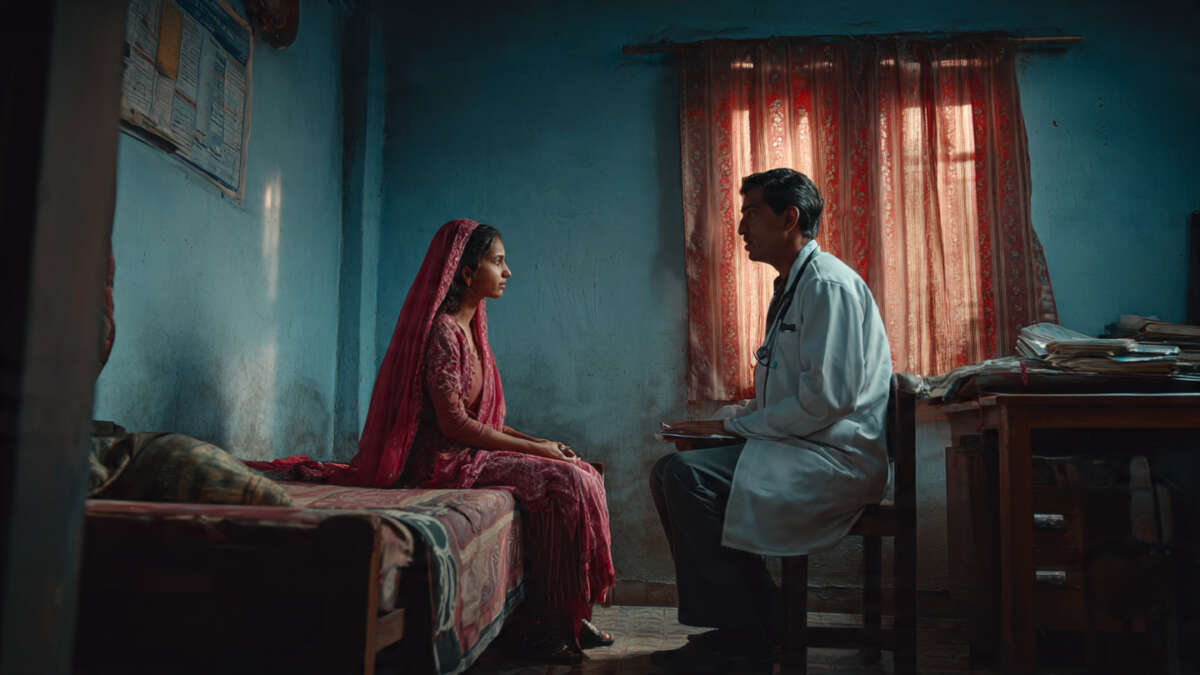
“Doctor Babu, I have three elder sisters,” she said, her voice as flat as a parched paddy field. “You see. I am my mother’s fourth daughter. So…they named me Felani.”
The lack of drama in her tone was what unsettled him most. There was no resentment, just a weary, automated repetition. It was as if she were reciting a grocery list rather than the tragedy of her birth.
“But still! To name a child, how come they thought ‘Discarded’?” Sen sputtered, his urban sensibilities reeling. He felt an urge to protest to the local authorities, or perhaps to the universe at large.
“Yes, Doctor Babu,” a voice chimed in from the side. Standing next to her was a dark-complexioned young man with eyes so startlingly soulful they seemed to belong to a different century. “Her elder sister is named Chayna. Because, you see, her parents didn’t ‘want’ (Chayna) her either. Rather, they wanted a boy.”
The young man offered this information with a gentle, self-deprecating smile, as if apologising for the lack of creativity in their village’s patriarchy.
Dr. Sen turned back to his computer, his fingers hovering uselessly over the keyboard. He was supposed to be diagnosing a chronic cough, but the word Felani was pulsating on the screen like a neon sign of collective failure.
He realised then that his shock wasn’t just for the family who had named her. It was for the comfortable world he’d come from, where names were chosen for their poetic lilt or their meanings of “Goddess of Wealth” or “Morning Dew.” Here, in the shadow of the old schoolhouse, names weren’t aspirations; they were honest, brutal receipts of a life already bargained for.
As he struggled to focus on the prescription, his vision blurred. It wasn’t just the North Bihar dust; it was the sudden, sharp realisation that while he was here to hand out paracetamol, he was woefully unequipped to treat the ache of being “unwanted.”
***
Dr. Sen stared at the flickering cursor on his laptop, the word Felani glowing back at him like a silent accusation. Outside, the midday heat of North Bihar had reached a fever pitch. A stray goat wandered into the school corridor, bleating a rhythmic protest against the lack of shade, while a local politician’s assistant loudly informed a group of elderly men that the free Vitamin C tablets were actually “energy pearls” gifted by the leadership.
Dr. Sen felt a familiar, creeping bile rise in his throat, a modern, educated nausea. It was the same feeling he got every Sunday back in the city while scrolling through the matrimonial columns: “Wanted: Fair-skinned bride, homely, convent-educated.” He thought of the medical representatives who visited his clinic, sliding glossy brochures across his desk for skin-whitening creams, their eyes gleaming with the predatory zeal of those who knew that in this country, a shade of melanin was often treated like a terminal diagnosis.
He looked at Felani, whose skin was the deep, rich colour of the very earth they stood on, the soil that yielded grain despite the drought, yet was deemed “unfortunate” by those who preferred the pallor of indoor cowardice.
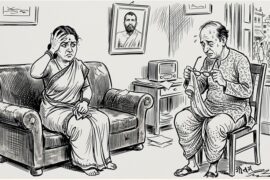
“Is there a cough, Felani?” he asked, his voice softening.
“Yes, Doctor Babu. Since the last storm, the Aandhi.”
As Dr, Sen checked her lungs, his mind drifted to the morning news he’d read on his phone before the signal died. The world felt like a poorly scripted farce. He thought of the “Information Wars” where truth wasn’t murdered, but simply buried under a mountain of shiny, digital garbage.
Here he was, in a crumbling school in northern Bihar, trying to heal a girl named ‘Discarded’ with a strip of generic antibiotics, while the rest of the world calculated market shares over the corpses of the innocent.
The irony wasn’t lost on him. He lived in an age where an entire city could be turned into a living hell for months, and the global response was a collective shrug and a thumb-swipe to the next viral reel of a dancing cat. We had become a species of onlookers, he thought, a civilisation of ‘likes’ and ‘shares’ with the moral spine of a jellyfish.
“Doctor Babu?” the dark-eyed young man whispered, noticing Sen’s glazed expression. “The computer… it is making a buzzing sound.”
Sen snapped back to reality. He realised he had been typing ‘Shameless’ into the notes field of the prescription software. He quickly hit backspace.
He looked at the queue of people outside, mothers holding babies, old men with cataracts, the “unwanted” and the “unseen”, all waiting for a fragment of his attention. He felt a sudden, sharp hatred for the deaf-and-dumb leaders of the world, those intellectual eunuchs who traded humanity for power. But mostly, he felt a self-deprecating sting. Who was he to judge? He would go back to his air-conditioned apartment tomorrow, order a pizza, and perhaps scroll past a headline about a bride burned for her dowry just to see what was trending on Netflix.
“I am giving you some medicine, Felani,” Sen said, his voice unusually thick. “And listen… names can be changed. You don’t have to be what they call you.”
The girl looked at him, a tiny, ironic smile playing on her lips, the smile of someone who had survived a thousand storms while the doctor was still learning how to open an umbrella.
***
The afternoon light in the schoolyard had turned a heavy, syrupy gold, casting long shadows across the cracked cement. Inside the makeshift clinic, the air was thick with the scent of phenyl, dried mud, and the communal exhaustion of three hundred patients. Dr. Sen’s computer screen flickered once more, the pixels blurring before his tired eyes.
In that moment of optic fatigue, a ghostly fragment of an old story, something he’d read in a dusty college library, surfaced in his mind like a drowned memory. It was the cry of an orphan girl from a century ago, a sharp, piercing lament: “Babumoshai, there comes a time on this earth when all the wise and the virtuous sit in stony silence… and the oppressed just stays oppressed, on and on and on.”
He shook his head, trying to dislodge the heavy literary melancholy. “Get a grip, Sen,” he muttered to himself. “You’re a medical professional, not a tragic poet.”
He reached for a tattered folder Felani had brought a collection of her “official life” in papers. Tucked behind a yellowed immunisation card was an old, handwritten prescription from a village quack. Dr. Sen squinted at the header.
“Wait,” he said, tapping the paper. “Who is this? Radhika Bedia Prasad? Now, that is a beautiful, classic name. Why isn’t this on your registration form?”
Felani didn’t answer. Instead, she ducked her head, a sudden, genuine flush of crimson creeping up her neck. She looked, for the first time that day, like a woman who possessed a secret worth keeping.
The dark-eyed young man beside her, whom Sen now realised was not just a companion but her husband, Giridhari Prasad, stepped forward. He pressed his palms together in a polite namaste, his expression a mixture of pride and gentle exasperation.
“Agyay, Doctor Babu,” Giridhari explained, his voice rich with rural sincerity. “That is her ‘called-at-home’ name. My family gave it to her after the wedding. But the officials… they are a difficult breed. They deleted it from the voter list. I tried to explain to the clerks that her birth certificate, the ‘good’ name given by her parents, was indeed Felani. But they wouldn’t listen.”
He paused, glancing at his wife with a look of such profound tenderness that Dr. Sen felt a sudden, sharp pang of envy for their simple clarity.
“My parents couldn’t bear to call her ‘Felani, the discarded,'” Giridhari continued, a subtle touch of irony dancing in his eyes as he looked at the government-issued ID. “They insisted on Radhika. Because, you see, Doctor Babu, in our house, she isn’t something thrown away. She is the Lakshmi of the home.”
Dr Sen sat back, the rickety chair groaning under the weight of his realisation. He had spent the last hour mourning the cruelty of the world, the apathy of leaders, and the tragedy of a name. He had positioned himself as the enlightened observer, the city doctor pitying the rural victim.
Yet, here was Giridhari, a man who likely couldn’t define ‘existentialism’ or ‘market shares’, quietly subverting a lifetime of rejection with a single, chosen name. He hadn’t waited for a revolution or a government policy; he had simply renamed his world.
Dr. Sen looked at the screen. He deleted the clinical, cold notes he had started. In the space for the patient’s name, he didn’t just leave the official ‘Felani.’ In brackets, in bold letters that felt like a small act of rebellion against the dusty schoolhouse and the silent world outside, he added: (Radhika).
“Radhika, take these twice a day,” he said, handing over the slip with a mock-serious flourish.
As the couple walked out into the hazy Bihar sunset, Giridhari protectively holding the umbrella over his wife’s head, Dr. Sen felt a little less like a tragic hero and a little more like a man who had just been schooled in the finest kind of medicine. He realised that while the world might be deaf, dumb, and blind, occasionally, someone in a small town remembers to speak the right name.