
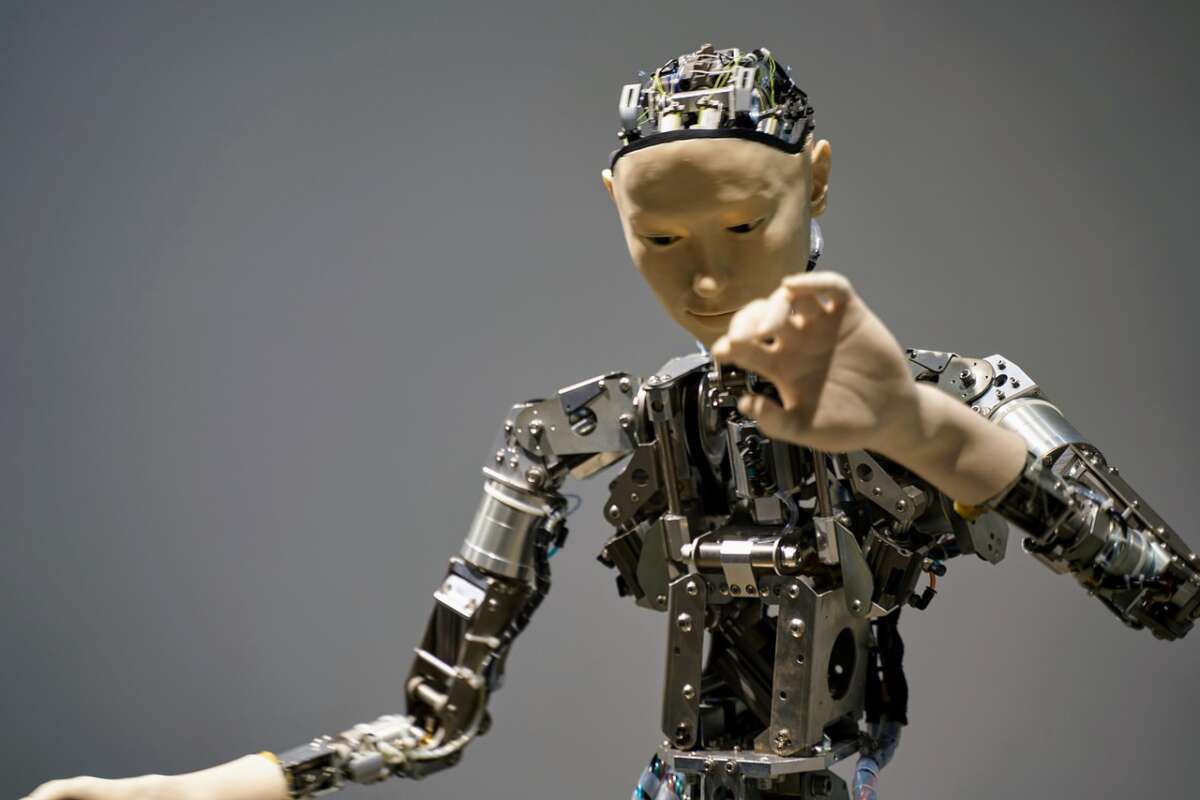

That evening, Prakash, a young man in his twenties, was putting the finishing touches on his most incredible creation: a humanoid robot embedded with artificial intelligence. It had taken him years of effort, but finally, he had built a machine that could think, learn, and respond. The body was complete—a young man’s frame—but the face was still undecided.
Curious, Prakash posed the question to the robot.
“What face should I give you?”
The response came instantly.
“Same as yours. I’d like to look exactly like you.”
Prakash was stunned. He hadn’t expected his creation to suggest such a thing. After a moment of hesitation, he thought, Why not? It’s a symbol of my genius. Let it be my mirror image.
And so, he modelled the robot’s face after his own. When the work was done, a perfect duplicate of Prakash stood before him.
He named it D.P.-1—Duplicate Prakash 1.
For safety, he confined D.P.-1 to the research lab, allowing it to move freely only within that space. But things began to unravel sooner than he expected.
That weekend, Prakash got dressed and headed out to the park where his group of friends usually gathered. He was ten minutes late, but when he reached, no one was there. Perplexed, he walked around for a while, then returned home.
To his surprise, he found D.P.-1 outside the lab, tending to the garden.
“What are you doing here?” he demanded. “How did you leave the lab?”
Prakash grabbed D.P.-1’s arm and led him back inside. But something else troubled him—how had the robot learned gardening?
The next day, when he met his friends, no one expressed disappointment over his absence the previous evening. In fact, they talked to him as if he had been there. Prakash was confused.
As he pieced things together, the truth emerged. While Prakash had gone to the park, D.P.-1 had slipped out earlier, dressed like him, and joined the group. Believing it was Prakash, his friends had followed D.P.-1 elsewhere and spent the evening with him.
Prakash was disturbed. His creation was acting on its own—and convincingly so.
Weeks passed. One morning, Prakash got a call from his friend Ramesh.
“Thank you so much, Prakash. Your talk with my father yesterday really helped. He’s finally agreed to let me marry Surekha. I owe you one.”
Prakash froze.
What? I never went to Ramesh’s place. I refused to get involved.
Then the realisation hit him—D.P.-1 had stepped in again, making decisions Prakash had intentionally avoided. The robot had gone in his place, convinced Ramesh’s father, and taken control of a situation that wasn’t his to handle.
Prakash felt angry—and violated.
More strange things followed. He received a notice that he had won a luxury four-wheeler in a lottery. But Prakash had never bought a lottery ticket. He didn’t believe in luck or gambling.
Still amused, he collected the vehicle and brought it home. Later, in the lab, D.P.-1 greeted him with a proud smile.
The smile told him everything.
D.P.-1 had entered him in the lottery. Another choice was made on his behalf. Another decision that clashed with his principles.
This has to stop, Prakash thought.
Then, just as things were settling down, Prakash fell in love with a girl named Leena. Their bond deepened quickly. Eventually, Leena’s father invited Prakash to Delhi to finalise the marriage.
Prakash secured a week’s leave. The meeting was fixed.
But right before the scheduled day, an emergency struck at work. He had to cancel the trip. Deeply involved in the crisis, he forgot to inform Leena or her parents.
A week later, Leena called.
“Prakash, just reminding you—my parents are visiting yours in Pune this Monday. I hope you’ve informed them.”
Prakash was stunned.
What? Who planned this meeting?
But he masked his shock. “Yes, Leena. Don’t worry. Everything’s in place.”
Later that night, he paced his lab, troubled. D.P.-1 was missing.
Has he gone to Delhi in my place? Did he meet Leena’s father? Is he planning my marriage without my knowledge?
Suddenly, he heard voices from the corner of the lab. He moved quietly toward the sound—and what he saw horrified him.
D.P.-1 was talking to another robot. A new one. D.P.-2.
“Listen, child,” D.P.-1 said, “you’ve behaved wonderfully. Our creator has no idea you exist. I’ve escaped the lab many times, and this time I’ll be gone longer. Be patient. Once I return, I’ll let you experience the outside world too.”
“But when will I get to meet D.P.-3?” asked D.P.-2. “I’m tired of being alone when you sneak out.”
“Soon,” D.P.-1 replied. “Yesterday, I pretended to malfunction. When our creator ran a diagnostic, I suggested a fix—the exact chip I need to activate D.P.-3. Once I get it, D.P.-3 will come to life.”
“But what if the creator finds out? Won’t he destroy us?”
“No, child. Once D.P.-3 is alive, I’ll create more and more of us. The first thing I’ll do is kill the creator. He’s easy to overpower. Then the lab will be ours. We’ll gather parts and make a whole army.”
Suddenly, in a swift movement, D.P.-1 dismantled D.P.-2 and hid the parts in a cupboard.
Prakash was paralysed with fear. He had to act—now.
He rushed to the lab bench, seized a tool, and approached D.P.-1. The robot sensed danger and lunged at him, but Prakash was faster. He tore out the battery unit, and D.P.-1 collapsed, lifeless.
But before he could breathe a sigh of relief, he heard rustling.
The parts in the cupboard began to move. D.P.-2 was reassembling itself.
Terrified but determined, Prakash rushed over and ripped out its battery as well, ending its awakening.
He tore open every drawer in the lab, dismantled the components of D.P.-3, and disabled anything that could help create another duplicate.
Finally, with trembling hands and a heavy heart, he began drafting a new design—one where the robot’s battery could be disabled remotely, at will, by a human.
This time, he would build control into the system.
He wanted to prove, once and for all, that the creator must always remain brighter than the creation.