

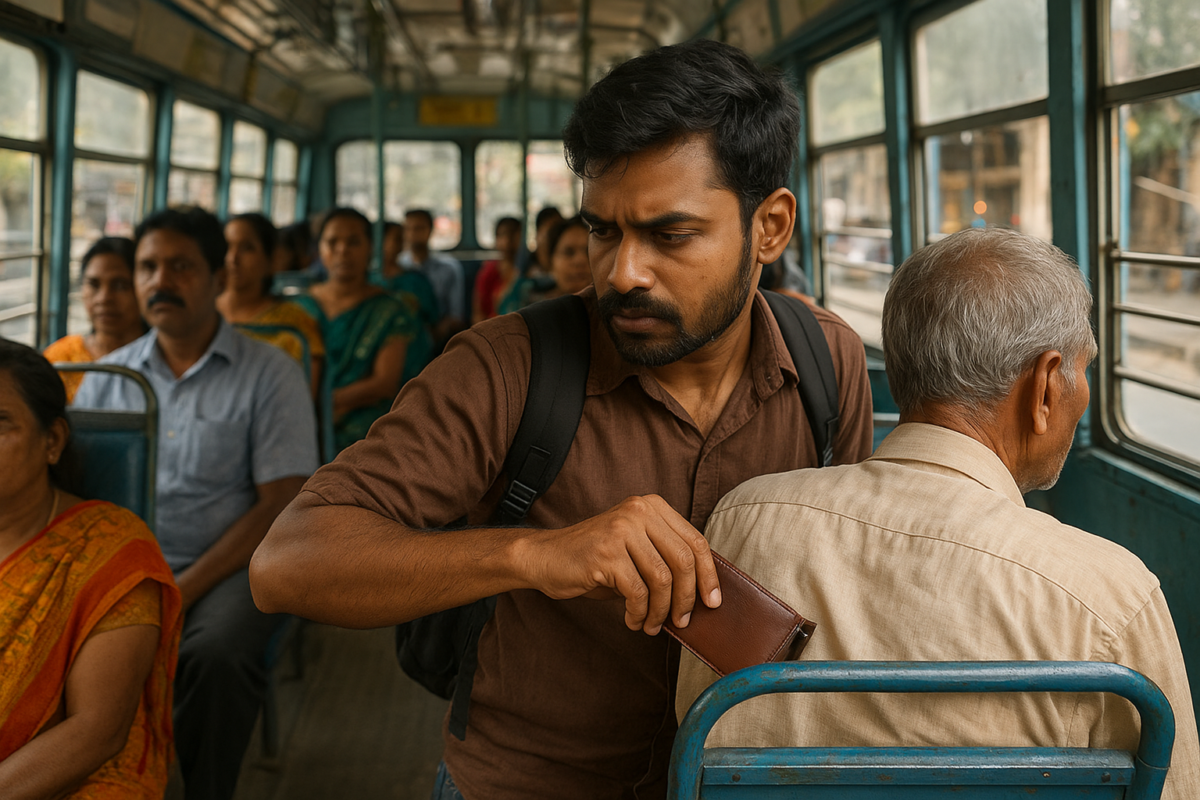

It is a humid Monday morning in October.
At the bus stands of Kolkata, office-goers jostle and push, fighting for space in packed private and state-run buses. Among them, Susanta is one of the lucky few to have claimed a seat in a private bus plying between Garia and New Town. By the time it reaches Ruby, the vehicle is already jam-packed, the aisles crammed, and the doorway crowded with passengers clinging to the bars at the gate.
The person sitting beside Susanta alights near the Science City crossing, and an old man takes his place. He wears a striped off-white shirt and formal trousers, sweat beading on his face in the stifling air of the bus. His head is full of white hair, and a fashionable, partially grey moustache frames his upper lip. Placing a leather office bag on his lap, he stares intently at his mobile phone.
Susanta can’t help but notice that both the bag and the mobile are pretty expensive.
After fiddling with his phone for some time, the old man takes out his wallet to pay the bus fare. As he fumbles for a 20-rupee note, the wallet opens briefly, revealing a flash of neatly stacked 500-rupee notes—enough to catch the eye of anyone paying attention. Handing the note to the conductor’s outstretched arm, the man indicates he will get off at the New Town bus stand, the last stop. Tucking the ticket into his pocket, he leans back against the seat and closes his eyes, hoping to steal a moment of rest. A large portion of the wallet protrudes from his trouser pocket—a quiet testament to his carelessness. By the time the bus approaches Sector V, he is fast asleep.
Susanta stands, preparing to get off at the next stop. Though the bus remains crowded, many passengers are already gathering to disembark. As the bus halts briefly, a wave of people surges toward the gate, each more impatient than the last.
Susanta weaves his way through the jostling crowd and steps onto the street. He breathes a deep sigh of relief, savouring the fresh air as it cools his face. Watching the bus disappear into the distance, he heads toward a nearby tea stall and settles onto an empty bench. He orders a cup of tea and an omelette. The stall is nearly empty; people rushing to Sector V are busy punching in for their morning shifts.
Susanta is in no hurry. Reaching into his pocket, he pulls out a wallet—not his own, for he doesn’t carry one. This belongs to the old man who sat beside him on the bus. Two years in this line of work have taught him well: his gang preys on crowded buses and busy public places throughout the day.
Susanta carefully flips through the wallet’s contents, scrutinising every card and slip of paper. No credit or debit cards—unfortunately, nothing to swipe electronically. But then his eyes land on the cash: six thousand rupees, neatly stacked and crisp. A quiet wave of relief washes over him; after days of empty pockets and missed chances, today’s haul more than makes up for the recent dry spell.
He leans back, taking his time to savour the omelette’s savoury flavours while sipping his tea slowly, letting the warmth soothe the morning chill. A fleeting image of the old man’s worn, sleeping face drifts into his mind, and for a brief moment, a pang of guilt stirs within him. But he quickly pushes it aside. Someone’s pain is another’s gain—that’s the harsh truth he’s learned to live by.
Susanta doesn’t carry a mobile phone. It is strict gang policy to avoid any electronic devices that could reveal their locations. After each morning’s trip, the members return home with their loot, lie low throughout the day, and meet at a predetermined location once the city goes to sleep. Tonight, the gang is scheduled to gather at Susanta’s house.
After finishing his breakfast, Susanta boards a return bus to his small rented apartment near Santoshpur. By the time the bus drops him off around 11 AM, he carefully locks the stolen items inside a steel almirah. When the gang assembles at night, all the cash and stolen goods are displayed for everyone to see. The member who acquired the money keeps 30%, while the remainder is divided among the others — ensuring no one goes home empty-handed. The stolen items are then sold to black market dealers for a cash payment.
This arrangement has been sufficient to sustain the six members of the gang. Despite their illicit activities, Susanta’s gang has gained notoriety for its professionalism. For years, they have managed to stay ahead of the police and local authorities by communicating exclusively through encoded handwritten notes, deliberately avoiding any digital trail.
Susanta takes a quick bath and prepares a simple meal of rice, dal, sabzi, and a boiled egg. After finishing his lunch, he lies down for a brief siesta. The rest of the day passes quietly, without incident. By the time Susanta finishes his dinner, the clock strikes ten. He switches on the television and waits for his accomplices to arrive.
Rahul is the first to show up at half past ten. He lives near Ballygunge and mostly works the ever-crowded Gariahat market, where the hustle and bustle provide ample opportunities for their trade.
“Look what I got today,” Rahul says, settling down on the sofa with a beaming smile. He spreads his loot across the centre table: two wallets and an expensive lighter. “Worth at least four thousand rupees in total,” he adds proudly.
Susanta shows him his prize wallet. “Well done, brother!” Rahul applauds, giving him a hearty pat on the back.
Within the next half hour, Suman, Sujay, Santanu, and Subhadip arrive. The six men open a bottle of cheap whisky, pouring generous pegs into their glasses before beginning their meeting.
“Judging by the items we’ve managed to steal, I’d say today was quite successful,” Santanu announces. The oldest member of the gang, he operates in North Calcutta and has been a professional pickpocket for over five years.
“Let’s make a toast,” he says, raising his glass. “To more stolen goods!”
“To more stolen goods!” the others echo, clinking their glasses together.
“But it looks like Susanta has outdone us today!” Suman remarks with a grin.
“Three cheers for Susanta!” they all shout in unison.
“Hip hip—hooray!” The chorus rises again, filling the room.
Susanta blushes, a shy smile tugging at his lips. At just twenty-three, he is the youngest member of the gang, and this moment of recognition feels like a rare and proud victory.
DING DONG!
Their celebratory mood is abruptly interrupted by the doorbell.
Sujay glances at the wall clock. “It’s 11 PM. Who could that be at this hour? Were you expecting someone, Susanta?” he asks, puzzled.
The others turn their attention to Susanta.
“It might be my neighbour,” Susanta replies, trying to sound casual. “Sometimes, he comes over to share a smoke at night. I’ll go see.” He stands up.
Taking a cigarette from the packet on the table, he walks to the door and opens it. In the pale glow of the streetlight, a figure stands silently against the dark backdrop of the night.
It’s not his neighbour. It’s an old man — white-haired, sporting a greying moustache, clad in a striped off-white shirt and formal trousers.
After a brief pause, Susanta recognises him: the very same old man whose wallet he stole that morning.
The shock of the unexpected visitor roots Susanta to the spot. He is frozen, unable to move or speak. A thousand thoughts flood his mind, but none explain the man’s presence at his doorstep.
The old man stands quietly, studying Susanta’s stunned expression. After what feels like an eternity, he finally speaks.
“Hello, Susanta. I hope you remember me. We met briefly this morning. How’s the celebration going?” he asks calmly, a faint smile playing at the corners of his lips.
Susanta can’t find his voice. A lump forms in his throat, choking off any words. The man knows his name. He knows his address. How is that possible?
“Judging by your reaction, I see you do remember me,” the old man says with a soft laugh. “I wonder if you remember the faces of all the people you pickpocket. Wouldn’t that be something?”
Susanta finally musters enough courage to speak, his voice shaky but urgent. “Who are you? How do you know my name? How did you find out where I live?” He blurts out the questions in rapid succession, then gasps for breath.
The old man remains calm, his voice steady and unhurried. “You seem quite surprised. Understandably so.” He pauses for a moment before continuing. “You see, I don’t just know you — I know all five of your companions gathered in your living room right now. But I must admit, it took a lot of planning and effort to get you all in one place.”
“You guys are slippery customers, I’ll give you that.”
With a slow, deliberate motion, the old man pulls a badge from his pocket. In the dim light, Susanta recognises the emblem of the Kolkata Police Department and the photo of the man himself. The text beside the picture is too small to read clearly, but the meaning is unmistakable.
The old man offers further explanations, fully aware of Susanta’s growing panic and confusion.
“Sandip Sarkar. Senior officer, Lalbazaar Detective Department,” he announces with firm authority.
Susanta’s face drains of colour; his throat tightens with dryness. Yet he remains rooted to the spot, as if the old man’s voice holds him captive.
“You see, young man, we set a trap for you — and you fell right into it.” The officer’s tone grows steady, deliberate. “We targeted you because we learned you were the youngest of the lot. There were five plainclothes policemen on the bus today, waiting to bait you into stealing from us. “As luck would have it, I was the one who got the seat beside you—and the one who offered my wallet for the taking.”
“What you didn’t realise was that two officers got off with you at your stop and followed you discreetly. We expected it to be challenging, but it seems the thrill of stealing 6,000 rupees dulled your usually sharp instincts. You led us straight to your home without any hesitation. From there, it was only a matter of waiting until night.”
“Our source informed us that all your friends would be gathering at your place tonight. And sure enough, every single one of them walked right through your front door.”
“So, here we are. Your time has finally come, Susanta. Time to face the consequences of your actions. It’s such a pity — a young boy like you choosing such a dark path. I hope you reflect on your choices and become a better man.”
For a fleeting moment, Susanta catches a faint trace of sadness etched into the detective’s weathered face.
With a snap of his fingers, the old man summons four police officers in full uniform from the shadows. All are armed and ready for the chaos about to unfold. They push Susanta inside and quickly overpower the other gang members with ease. Within five minutes, all six are handcuffed to the grills of the two living room windows.
The officers conduct a thorough search of the house, gathering all the stolen goods onto the center table.
“Impressive,” Sandip remarks, inspecting the items with interest. “Quite a handsome haul for a single day. Unfortunately for you, we’ll be seizing all of this and taking it back to the station.”
The police carefully pack everything into transparent, zip-tied containers and prepare to leave.
Sandip moves toward the door with his team. “Alright, gentlemen, I’m off now. One officer will stand guard outside your house. We’ll return to the station and send a team to collect you. Goodnight — see you soon.”
With that, he steps out through the main gate, locking it firmly behind him.
The pickpocket gang is utterly speechless. They sit frozen, their eyes locking with one another in silent confusion, unsure of what to say or how to react. The weight of their predicament presses heavily on their chests. Their limbs feel numb, as if their bodies refuse to move, trapped by the harsh reality settling in around them. Slowly, the realisation dawns—they are caught, their freedom slipping away like sand through fingers. They wait in defeated silence for the officers to return and escort them to the police station, the sound of distant city noise filtering through the closed windows.
Susanta’s gaze drifts to the night sky beyond the glass. The crescent moon peeks softly from behind a wispy cloud, casting a pale, gentle glow over the quiet streets below. The cool night air seems to seep into the room through cracks in the window frame, contrasting sharply with the stifling tension inside. A faint, almost imperceptible smile curls on Susanta’s lips.
A part of him feels an unexpected sense of relief, as if a heavy burden he had carried for years has finally been lifted. Deep inside, buried beneath layers of hardened survival instincts and desperate choices, lies a part of him that has always loathed the deception and theft — a part now aching to be free.
Tonight, that part will finally be heard.
He knows his life will change forever. The punishment awaiting him is uncertain, but he faces it without fear. There is a quiet resolve settling over him, a solemn promise whispered to the shadows: he will never deceive or steal from another soul again.
For the first time in a long time, Susanta feels the fragile hope of redemption stirring within him, fragile but real — like the pale crescent moon lighting the darkness outside.
***
Outside, the police officers get into a black SUV parked behind Susanta’s house. Sandip sits beside the driver, and the others load the seized items inside. As the car moves through the streets, silence hangs for two minutes.
Then one officer speaks up, addressing Sandip.
“We got them good, boss! You’re a genius! How easily they believed your words, those fools! They think they’re professionals, but they don’t know there are levels to this. I can still vividly recall their dumb faces as we were leaving!” He bursts out laughing.
The others join in.
A smile forms on Sandip’s face.
“It’s astounding what a few police uniforms and a fake ID can do,” he exclaims. “People panic at anything resembling a police uniform. And if you’re a notorious pickpocket, you’re naturally terrified. That worked in our favour.” He takes out a water bottle and sips from it.
“Besides, this had to be done. They were becoming too dangerous. This city isn’t big enough for two pickpocket gangs. Survival of the fittest, as Darwin said,” Sandip finishes with a smile.
The others nod in unison, hanging on their leader’s every word. Today, they are the bigger gang—and must eliminate all competition to stay on top.