

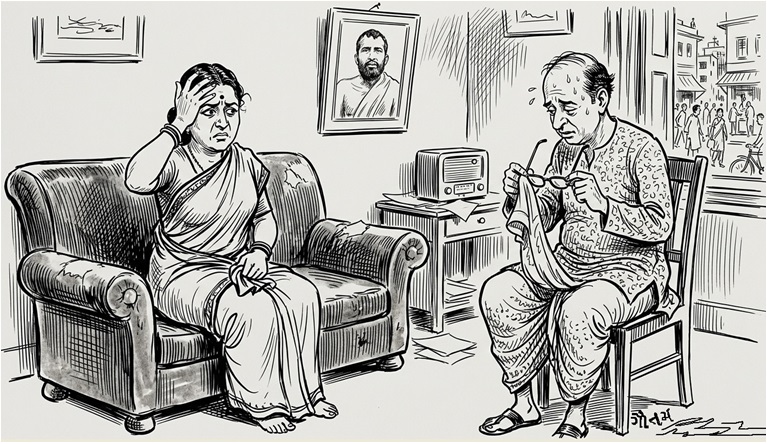

The dust in the drawing room of the Basu household never quite settled, but on that fateful afternoon the Higher Secondary results were announced, it seemed to hang suspended in the shaft of pale, humid sunlight like an audience waiting for a cue.
Sushma Devi sat on the edge of the velvet-upholstered sofa, her palm pressed firmly against her forehead as if holding her thoughts from scattering into the neighbourhood. Across the room, her husband, Naren babu, was carefully wiping his spectacles with the corner of his dhoti, his forehead beaded with a perspiration that had very little to do with the stubborn West Bengal summer.
“If we can push Bablu and Tupur at least into B.Com at the evening college,” Sushma murmured, her eyes fixed on the framed portrait of Ramakrishna Paramahansa on the wall, “we might still be able to look Nukur-babu in the eye at the evening bazaar. His nephew got ninety-two per cent, you know.”
Naren babu let out a slow, deflating sigh. He pulled a faded cambric handkerchief from his pocket to mop his brow, his mind drifting toward the cold, ledgered reality of his finances. He was already thinking of taking a loan from his provident fund. The word ‘donation’ tasted like stale neem leaves in his mouth.
Outside the window, the world belonged to the conquerors.
And for Bablu and Tupur, the Basu siblings, the declaration of the results was not a verdict but an eviction notice from the prison of textbook parameters. They were stepping onto the threshold of ‘College Life’, a mythical kingdom they envisioned as an endless stretch of shared cigarettes, film magazines, and afternoon adda over plates of oily vegetable chops. They were, in their own minds, ascending the very steps of ‘the Vaikuntha’, the paradise.
—
The Overture of Flight
Tupur was the first to catch the wind. Having discarded her high school uniforms like a shed skin, she moved about the house with a sudden, floating grace. The dining table, which had been her executioner’s block for the past two years, was now just a piece of wood. Standing by the veranda, she let her voice drift over the neighbour’s roof:
“Main chali main chali, dekho pyaar ki gali, mujhe roke na koi…”
Meanwhile, Bablu had secured a tactical victory. Naren babu, in a weak moment of paternal optimism months ago, had promised a motorcycle if the boy passed. Now, the keys were in his hand, and Bablu was the undisputed emperor of the grand trunk road, flanked by a court of three boys clinging to the pillion seat.
“Main nikla gaddi le ke, sadak pe ek mod aaya…”
From the bedroom window, Naren babu watched the blue exhaust of the machine vanish into the lane. He turned to Sushma, who was pouring milky tea into two chipped porcelain cups.
“Did you hear that?” Narenbabu said, shaking his head with a satirical smile. “Your son used to say he would make the family name famous. From what I see now, he’ll ensure even my name is struck from the municipal records.”
He took a sip of the sweet, lukewarm tea, muttering under his breath the anthem of all betrayed fathers:
“Papa kehte hain bada naam karega, beta hamara aisa kaam karega…”
—
The Illusion of the First Semester
Admission was secured, thanks to a substantial dent in Naren babu’s savings and a few awkward cups of tea with an influential local committee member. With the college identity cards hanging from their necks like medals, all discipline vanished into the humid air of Calcutta. Study hours became urban legends. Tupur and Bablu sang in a silent, rebellious chorus that echoed through the corridors of their respective campuses:
“Main chahe yeh karoon, main chahe woh karoon, meri marzi! Mauja hi mauja!”
But the universe, much like the university registrar, possesses a grim sense of timing.
Six months dissolved like sugar in hot lemon tea. When the syllabus finally unveiled itself, it did not arrive as a friendly guide but as a multi-headed demon from the Puranas. Tupur found herself trapped in the cavernous college library, surrounded by the smell of rotting paper and binding glue, tears blurring the fine print of her history textbooks.
“Yeh kahaan aa gaye hum? Yoon-hi saath chalte chalte…”
Across town, Bablu sat in a Statistics lecture where the professor’s chalk moved across the blackboard with the speed of a runaway train. Whether the symbols were Latin, Greek, or simple hieroglyphs, Bablu could not tell. He looked at his notebook, which remained as pristine as a fresh shroud, and lamented his total disorientation:
“Lakho tare aasman mein, ek magar dhoonde na mila…”
The examination hall arrived with the suddenness of a winter chill. Bablu, relying on a piece of paper intricately folded and tucked into his watch strap, found his universe shrinking. The invigilator, a man with thick eyebrows and a soul devoid of mercy, stationed himself exactly three paces from Bablu’s desk. In the suffocating silence of the hall, Bablu’s heart screamed a desperate plea to those unmoving, watchful eyes:
“Mera chain vain sab ujda, zalim nazar hata le…”
On the day the semester results were pinned to the notice board, the Basu household was shrouded in the solemnity of a hospital waiting room. Sushma Devi had already dispatched a neighbour to offer a hibiscus flower and five rupees at the Kalighat temple, while Bablu stood before the glass case on campus, his knees turning to sand.
“Dhak dhak karne laga, mora jiyra darne laga…”
—
The Long Walk
The transition from the college canteen to the employment exchange was short, marked only by the wearing down of Bablu’s cheap leather sandals.
Dressed in a stiff, borrowed tie that smelled faintly of mothballs, Bablu sat before a panel of corporate interviewers whose faces resembled blank sheets of legal paper. Within three minutes, he realised that his years of ‘clever shortcuts’ had left him with an education as thin as tissue paper. Standing before the mirror in the office restroom afterward, adjusting his tie, the reflection asked a question he couldn’t answer:
“Main aisa kyun hoon? Main aisa kyun hoon?”
Then, there came the years of the pavement. The friends who had shared the motorcycle rides had drifted into their own quiet corners of survival. The ‘mauja’ was gone; the grand trunk road was now just a hot stretch of asphalt between offices that had “No Vacancy” signs hanging from their iron gates.
“Chal akela, chal akela, chal akela, tera mela peeche chhoota…”
Eventually, through a stroke of ordinary fortune that felt more like a compromise than a victory, Bablu secured a desk. It was a clerk’s post in a small, damp office near the railway tracks, where the salary barely managed to balance the monthly grocery bill. Sitting beneath a whirring, rusted ceiling fan, sorting through mountains of yellowing receipts, Bablu looked at the ink stains on his fingers and surrendered his youth to the system:
“Mujhe tumse kuch bhi na chahiye, mujhe mere haal pe chhod do…”
—
The Autumn of the Song
Years later, the evening fell gently over the Basu household. The motorcycle had long been sold, replaced by the quiet regularity of a local train pass.
Bablu, now grey at the temples and carrying the slight stoop of a man who spent his life over ledgers, sat in the old drawing room. The colourful glasses of his youth were gone, replaced by a pair of reading spectacles identical to the ones his father used to wear. He looked out at the street where another batch of boys was shouting about college admissions.
He realized then that the grand ‘Gitamala’ The Garland of Songs, the musical string of dreams they had woven after the Higher Secondary results, had merely been a trick of the light. Fame and fortune were the mirages of the afternoon; only the quiet evening remained.
“Naam gum jayega, chehra yeh badal jayega…”
Naren babu, now a very old man sitting in his easy chair by the corner, adjusted his shawl. He looked at his son, and thereafter at Sushma, who was carefully counting the laundry. With a small, self-deprecating smile that carried the wisdom of a lifetime of small defeats, the old man wiped his lenses one last time.
“You see, Sushma,” Naren babu said softly, his voice dry but amused, “life, after all, isn’t actually a ‘garland of favourite songs’. It’s a full-fledged ‘garland of lamenting’, a string of tears, with just enough rhythm to keep us marching. What do you say?”
































An amusing yet quietly heartbreaking portrait of middle-class Bengali life. Humorous on the surface but deeply reflective underneath.
Thank you for your feedback